
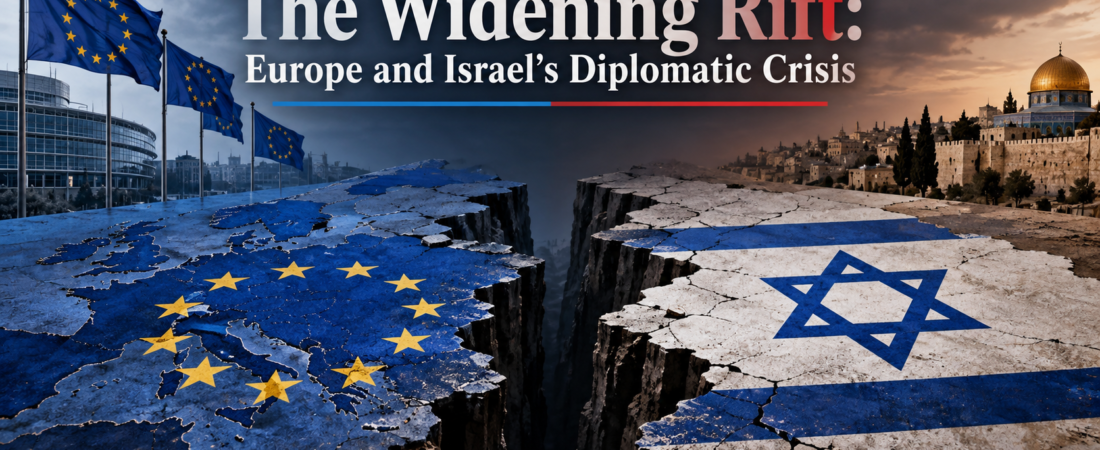
The Widening Rift: Europe and Israel’s Diplomatic Crisis
A profound geopolitical shift is unfolding across the European continent. Long characterized as a “payer, not a player” in Middle Eastern diplomacy, Europe has collectively pivoted toward direct economic intervention, sparking a fierce diplomatic battle with Israel.
The latest and most severe friction points highlight a fracturing relationship and the emergence of a newly divided Europe.
The Settlement Trade Bans
The current crisis was ignited by a coordinated announcement from the United Kingdom, France, and Canada introducing strict national import bans on all goods and services originating from Israeli settlements in the occupied West Bank.
UK Foreign Secretary Ed Miliband delivered a scathing speech to the House of Commons, declaring the occupation “unlawful” and accusing extreme elements of engaging in the “ethnic cleansing” of Palestinians. The move marks a dramatic divergence from traditional U.S. policy, which historically shielded Israel from such unilateral Western measures.
The joint effort quickly gained broader European traction. A coalition of 11 European countries including Spain, Ireland, Belgium, Norway, Sweden, and Poland have aligned to back national or European-level trade restrictions on settlement products. They point to an unprecedented surge in West Bank settler violence and the formal advancement of controversial expansion projects, like the E1 settlement corridor, as direct threats to a viable two state solution.
European Coalition Banning Settlement Products
United Kingdom
France
Ireland
Spain
Belgium
Norway
Sweden
Poland
Denmark
Finland
Iceland
Portugal
Israel’s Thunderous Response
Israel’s reaction was immediate and uncompromising. Viewing the trade bans not as a symbolic gesture but as a direct assault on its sovereignty and territorial integrity, Israeli Foreign Minister Gideon Sa’ar condemned the European measures as “morally distorted.”
In a rapid wave of retaliation, Israel launched a series of aggressive counter-measures:
- Consulate Closure: Israel formally ordered the closure of the British Consulate in East Jerusalem, which historically served as the primary diplomatic channel to the Palestinian Authority.
- Security & Aid Evictions: British representatives were ordered to withdraw from the International Gaza Support Center in Kiryat Gat, and the British Support Team in Ramallah was barred from training Palestinian Authority security forces.
- Travel Bans: Israel banned entry to 12 British elected officials and various foreign nationals accused of participating in anti-Israel boycott activities.
A Fractured European Continent
While Western Europe unites to pressure Jerusalem, Israel has successfully navigated growing political divisions within the European Union to secure vital diplomatic lines.
Because sweeping, EU wide foreign policy sanctions require unanimous consensus from all 27 member states, Israel’s staunchest allies have managed to systematically block full EU trade embargoes. Germany, the Czech Republic, and Greece have actively opposed broader sanctions, arguing for maintained cooperation, particularly in the fields of defense and technology.
Concurrently, Israel achieved a major diplomatic breakthrough in Central Europe. Israel opened its first-ever resident embassy in Slovenia. The dramatic policy pivot follows the rise of Slovenia’s right-wing government led by populist Janez Janša, who effectively reversed the previous administration’s pro-Palestinian stance. This diplomatic thawing in Ljubljana stands in stark contrast to the escalating isolation Israel faces in London and Paris.
What Lies Ahead
The coordinated bans represent a point of no return for Euro-Israeli relations. By directly targeting the economic lifeblood of the settlement enterprise, European nations are attempting to draw a hard legal boundary on the ground.
With a co-chaired meeting scheduled at the United Nations General Assembly later this month to push these measures globally, the diplomatic standoff between Israel and its largest trading bloc is only expected to intensify.