
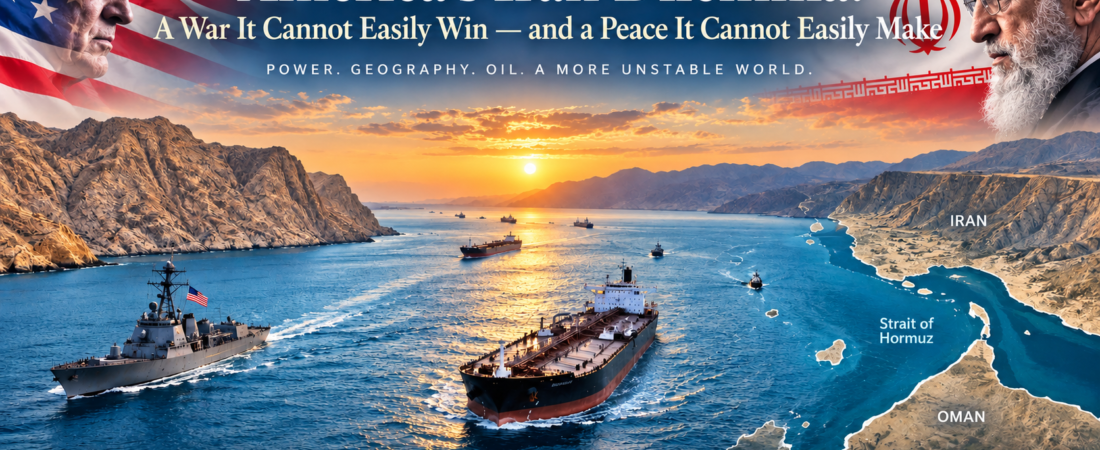
The United States possesses overwhelming military power. Iran possesses geography, endurance and the ability to impose costs far beyond its borders. Six months into their conflict, that imbalance has produced a dangerous paradox: Washington can inflict enormous damage on Iran, but turning military superiority into a lasting political settlement has proved far more difficult.
Oil has climbed above $100 a barrel again. Tankers have been attacked. Traffic through the Strait of Hormuz has been severely disrupted, and the consequences are reaching far beyond the Middle East.
What began as a confrontation over Iran’s nuclear program and regional power has become something larger: a test of whether overwhelming military strength can force a determined regional power to accept political terms it considers unacceptable.
The United States can destroy Iranian military infrastructure. It can blockade ports, impose sanctions and strike Iranian forces. But none of those capabilities automatically answers the most important question:
What would victory actually look like?
Military Superiority Is Not the Same as Political Victory
There is little doubt about which country possesses greater conventional military power.
The United States has the world’s most sophisticated military, global logistics, advanced aircraft, submarines, precision weapons, intelligence networks and powerful regional allies.
Iran cannot realistically match that strength weapon for weapon.
But wars are not always decided by which side can destroy more targets.
A political victory requires something more: forcing the opponent to accept an outcome it otherwise would reject.
That distinction is crucial.
Iran does not necessarily have to defeat the United States militarily. Its strategy can instead be to survive, preserve enough military capability to retaliate, maintain pressure around the Persian Gulf and make continued confrontation increasingly expensive.
For Washington, therefore, the problem is not simply how to hurt Iran.
It is how to make that pain produce the political result Washington wants.
Six months of conflict have demonstrated how difficult that can be.
Iran’s Most Powerful Weapon May Be Geography
Look at a map and Iran’s strategic advantage becomes immediately apparent.
Along Iran’s southern coastline lies the Persian Gulf and, at its eastern entrance, the Strait of Hormuz.
This narrow waterway between Iran and Oman is one of the most important energy corridors on Earth.
Before the current disruption, enormous quantities of oil and liquefied natural gas from Saudi Arabia, Iraq, Kuwait, Qatar, the United Arab Emirates and Iran moved through or depended heavily upon the Gulf shipping system.
Iran does not need to sink the U.S. Navy or control the world’s oceans to cause economic damage.
It only needs to make navigation through this critical region dangerous enough that tankers are attacked, shipping is delayed, insurers demand higher premiums and traders fear that supplies may not arrive.
That fear alone can move markets.
On September 9, Brent crude settled above $100 a barrel as renewed American and Iranian attacks intensified concerns about Gulf supplies and shipping.
The battlefield, therefore, extends far beyond Iran.
It reaches the gas station.
The trucking company.
The airline.
The factory.
And eventually the grocery store.
The World Pays for a Regional War
This is what makes the conflict different from a war whose economic consequences remain largely inside the countries fighting it.
Energy is embedded in almost everything.
Higher oil prices raise transportation costs. Diesel affects trucking, agriculture and shipping. Petroleum is also used in plastics, chemicals and countless industrial products.
When energy becomes more expensive, businesses frequently pass at least part of that cost to consumers.
And the consequences are not confined to the United States.
Countries in Africa and Asia that import large amounts of energy can be particularly vulnerable because higher oil prices require them to spend more foreign currency simply to keep vehicles moving, factories operating and electricity flowing.
A confrontation concentrated around a relatively small body of water can therefore become a worldwide economic event.
That gives Iran something military statistics alone cannot adequately measure:
leverage.
But Iran Is Paying an Enormous Price Too
This does not mean Iran is winning.
Far from it.
American economic pressure, sanctions and restrictions on Iranian trade have inflicted severe damage. Iran faces shortages, inflation, pressure on its currency and difficulty importing goods.
The longer the confrontation continues, the greater the strain on Iranian society and the Iranian state.
That creates Washington’s central calculation: perhaps enough economic pressure will eventually force Tehran to compromise.
But this strategy carries an important uncertainty.
Economic suffering does not automatically produce political surrender.
Governments can endure extraordinary economic pain when their leaders believe that accepting an opponent’s demands would threaten their security, legitimacy or survival.
Iran’s leadership may therefore calculate that enduring economic hardship is preferable to accepting an agreement it considers humiliating or strategically dangerous.
This transforms the conflict into a contest of endurance.
Why Is an Agreement So Difficult?
The tragedy is that Washington and Tehran have already demonstrated that they can negotiate.
Earlier attempts at ceasefires and understandings temporarily reduced fighting. Negotiations addressed issues surrounding the Strait of Hormuz, sanctions and Iran’s nuclear program.
But the underlying disagreements remained.
Washington wants guarantees concerning Iran’s nuclear activities and secure passage through Hormuz. Tehran wants sanctions relief and rejects arrangements it believes would leave it economically vulnerable while stripping away important strategic leverage.
The nuclear issue makes the problem even more difficult.
Iran insists its nuclear program is peaceful. The United States has sought extensive restrictions and verification intended to ensure Iran cannot develop a nuclear weapon.
From Washington’s perspective, allowing Iran to retain capabilities that could eventually contribute to a weapons program creates an unacceptable security risk.
From Tehran’s perspective, surrendering strategic capabilities while remaining exposed to sanctions and future military pressure can look equally unacceptable.
Both sides therefore confront the same problem from opposite directions:
The concessions that could reassure one side may make the other side feel less secure.
The Strait of Hormuz Has Become a Bargaining Table
This is why Hormuz is more than a shipping route.
It has become part of the negotiation itself.
For Washington and its allies, unrestricted navigation through the strait is essential.
For Tehran, influence over Hormuz provides one of its most powerful bargaining tools.
Giving that leverage away without receiving major concessions would weaken Iran’s negotiating position.
But continuing to disrupt shipping invites greater military and economic pressure.
Iran therefore cannot use the Strait indefinitely without hurting itself.
And the United States cannot simply ignore the disruption without accepting serious consequences for global energy markets.
Each side possesses tools capable of hurting the other.
Neither has yet found a formula that converts those tools into a stable peace.
What Would American Victory Mean?
This may ultimately be the most uncomfortable question.
If victory means destroying Iranian military facilities, the United States can accomplish enormous destruction.
If victory means weakening Iran’s economy, Washington has already demonstrated considerable ability to do that.
But if victory means creating an Iran that permanently accepts Washington’s preferred nuclear restrictions, stops threatening Gulf shipping, abandons military retaliation and accepts a new regional balance on American terms, the task becomes dramatically more complicated.
Iran is a country of roughly 90 million people occupying a vast and mountainous territory at the crossroads of the Persian Gulf, Central Asia, the Caucasus and South Asia.
Military power can destroy infrastructure.
It cannot easily erase geography, nationalism, political ideology or a state’s determination to preserve what its leaders consider vital national interests.
That is why the distinction between winning battles and winning a war matters.
The Dangerous Middle Ground
The United States may be too powerful for Iran to defeat conventionally.
Iran may be too large, too resilient and too strategically positioned for Washington to easily compel politically.
That leaves both countries trapped in a dangerous middle ground.
Iran can continue imposing costs, but every additional month damages its own economy and population.
The United States can continue applying military and economic pressure, but prolonged instability threatens global energy supplies, raises prices and creates costs for American consumers and allies.
Meanwhile, every new attack creates another opportunity for retaliation.
And every retaliation creates another opportunity for miscalculation.
The greatest danger may therefore not be that either side deliberately chooses an unlimited war.
It may be that both sides continue believing that one more strike, one more sanction or one more act of pressure will finally force the other to yield.
A War Neither Side Can Easily Finish
The confrontation between the United States and Iran illustrates an old lesson of international politics.
Military superiority and political control are not the same thing.
America can inflict damage on Iran that Iran cannot inflict on America in equal measure.
But Iran does not need equality.
It needs endurance, geography and enough retaliatory capability to make the price of an American victory increasingly difficult to define.
Iran faces its own impossible calculation. Resistance preserves leverage, but prolonged resistance is inflicting enormous economic damage on the country it is trying to defend.
That is why negotiations remain both necessary and extraordinarily difficult.
Washington wants Iran to conclude that resistance costs too much.
Tehran wants Washington to conclude that forcing complete submission costs too much.
Between those two calculations lies the Strait of Hormuz, the world’s energy markets and millions of people who have no role in the conflict but are increasingly paying its price.
America may be too powerful for Iran to defeat. Iran may be too large, too resilient and too strategically positioned for America to easily compel. Between those two realities lies a war neither side has yet found a way to end.
The Wider Chronicle — Go Beyond the Headlines