
September 13, 2026
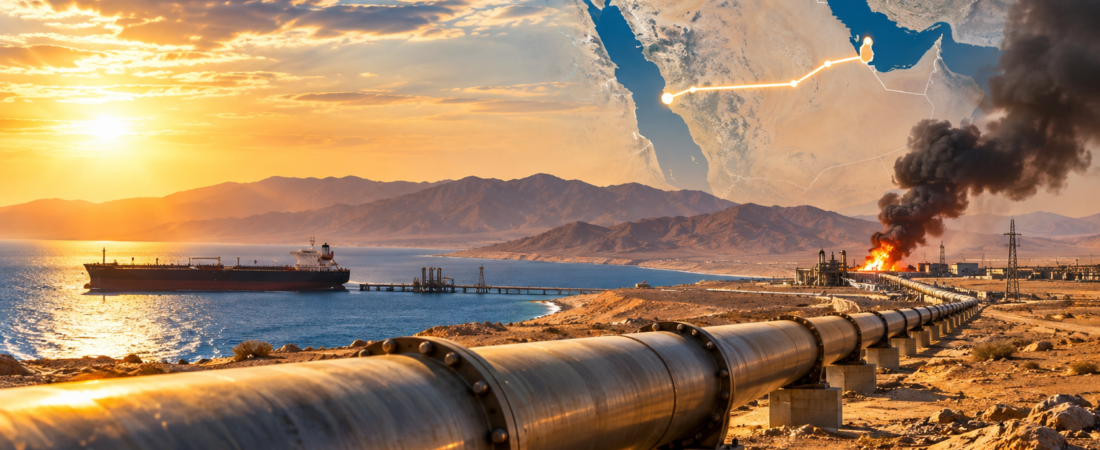
For years, Saudi Arabia’s East–West Pipeline was treated as an insurance policy.
If conflict ever threatened shipping through the Strait of Hormuz, Saudi crude could travel hundreds of miles across the kingdom and reach the Red Sea instead. It was one of the most important backup routes in the global energy system.
Now that insurance policy has itself come under attack.
Multiple drone strikes hit sections of the East West Pipeline in the Riyadh and Madinah regions, forcing Saudi authorities to shut the system down while emergency teams assess the damage.
At another time, an attack on a pipeline would have been a serious regional incident. Today, it carries much greater consequences.
The Middle East is already struggling with disrupted shipping, rising military tensions and uncertainty around the Strait of Hormuz. Damage to the Saudi alternative route means the world is being reminded of an uncomfortable reality:
There are only so many ways to move Middle Eastern oil safely to global markets.
What Happened
Saudi Arabia says several drones launched from Iraqi territory targeted the East West Pipeline, causing injuries and damage.
The kingdom shut the pipeline as a precaution while technical teams inspected the system and worked to determine how quickly normal operations could resume.
The pipeline stretches across Saudi Arabia from the oil producing east toward Yanbu on the Red Sea. Its strategic importance has increased enormously because it allows Saudi crude to avoid the Strait of Hormuz.
Saudi Arabia has so far chosen not to retaliate, giving the Iraqi government an opportunity to investigate the attack and prevent Iraqi territory from being used for further strikes.
No group has publicly claimed responsibility for the pipeline attack.
That distinction matters. Iraq is home to several Iran-aligned armed groups, but the presence of those organizations does not by itself establish who ordered or carried out the strike.
Why It Matters
This is bigger than one damaged pipeline.
Saudi Arabia is the world’s largest crude exporter, and the East West system has become one of its most important tools for keeping oil moving during the wider Middle East crisis.
Roughly four million barrels per day have recently been moving through the route equivalent to about 4% of global oil supply.
If the shutdown lasts only a few days, Saudi storage facilities may help cushion the disruption. But if repairs take weeks, the pressure becomes much more serious.
The world would then face problems at multiple energy chokepoints at the same time.
The Strait of Hormuz, connecting the Persian Gulf with the Arabian Sea, remains essential to global energy trade. On the opposite side of the Arabian Peninsula, instability around Yemen and the Bab al-Mandab threatens another route connecting the Red Sea with the Indian Ocean.
The East–West Pipeline was supposed to reduce Saudi Arabia’s dependence on those vulnerable waterways.
Its shutdown removes part of that safety net.
Oil markets have already reacted sharply, with crude prices above $100 a barrel as traders calculate how much supply could disappear if the disruption continues.
And oil prices rarely remain an oil-industry problem.
Higher crude prices eventually reach airlines, trucking companies, factories and consumers. Transportation becomes more expensive. Food distribution costs rise. Governments that import large amounts of energy face greater pressure on their currencies and budgets.
A pipeline damaged in Saudi Arabia can eventually show up in the price of groceries thousands of miles away.
Who Benefits and Who Loses?
There are few real winners in a prolonged energy crisis.
Other major oil producers could benefit financially from higher prices, particularly countries capable of maintaining exports while Saudi supplies are constrained.
Energy companies outside the immediate conflict zone may also enjoy stronger revenues.
But oil-importing economies face the opposite problem.
Europe and major Asian economies remain highly exposed to international energy prices. Developing countries are particularly vulnerable because expensive fuel can drain foreign currency reserves and increase the cost of transportation, electricity and food.
American consumers are not insulated either. Even though the United States produces enormous quantities of oil, petroleum is traded in a global market. Major international supply disruptions can therefore push American fuel prices higher as well.
Saudi Arabia itself faces perhaps the most complicated calculation.
The kingdom has spent decades building redundant infrastructure precisely so that regional conflict would not completely disrupt its exports. An attack on that infrastructure demonstrates that pipelines can become strategic targets just as easily as ports and tankers.
What May Happen Next
The immediate question is how quickly Saudi Arabia can restore the pipeline.
Saudi Arabia has repaired major energy infrastructure rapidly before, and the kingdom possesses significant technical capacity and storage. A quick reopening could calm markets.
A prolonged shutdown would be different.
Saudi storage at Yanbu can maintain exports temporarily, but those reserves are not unlimited. If repairs stretch beyond the available buffer, Saudi exports could begin falling more sharply.
The second question is political.
Riyadh’s decision not to retaliate immediately gives Baghdad an opportunity to demonstrate that it can prevent armed groups from using Iraqi territory to attack neighboring states.
But another strike could change that calculation.
The larger danger is escalation. If Saudi Arabia retaliates against forces inside Iraq, or if additional attacks hit Saudi energy infrastructure, what is currently an energy emergency could develop into a broader regional confrontation.
Diplomacy is therefore becoming almost as important as pipeline repairs.
The Wider Picture
For decades, the global economy assumed that Middle Eastern oil would continue flowing even during political crises.
That assumption is being tested.
Hormuz is vulnerable. The Red Sea is vulnerable. Pipelines are vulnerable.
And when several routes come under pressure simultaneously, the question is no longer simply how much oil the Middle East can produce.
It becomes something more fundamental:
Can that oil still reach the rest of the world?
That is why the Saudi pipeline strikes matter far beyond Saudi Arabia.
They expose how a regional conflict can travel through pipelines, shipping lanes and financial markets — eventually reaching fuel pumps, factories and households around the world.
The Wider Chronicle — Go Beyond the Headlines.