
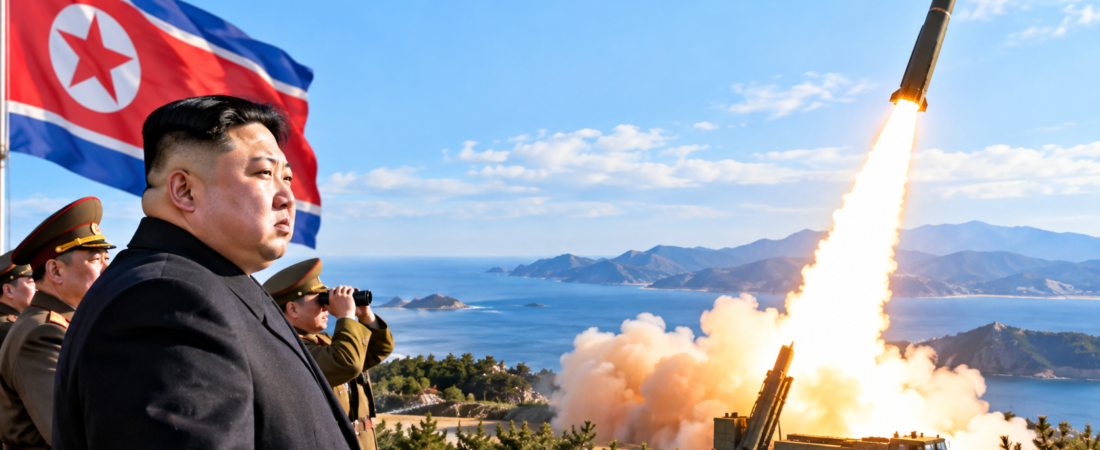
North Korea has tested what it calls a new weapons system, putting its rapidly advancing missile program back in the spotlight and raising a familiar but increasingly important question for South Korea, Japan and the United States: How difficult would the next generation of North Korean missiles be to stop?
North Korean state media said Kim Jong Un personally supervised the test, describing it as a success and an important step in strengthening the country’s military capabilities.
But beyond Pyongyang’s announcement, the test deserves attention because of what the weapon may be designed to do.
What Was Tested?
South Korea’s military detected two short-range ballistic missiles launched from the Wonsan area. According to South Korean assessments, the missiles traveled roughly 450 kilometers and 600 kilometers.
North Korea presented a different picture. State media released images and information suggesting a considerably longer flight and identified the weapon as a new system.
Analysts examining the photographs believe the missile may be the Hwasongpho-11Ma-1, an upgraded version of North Korea’s short-range ballistic missile family.
More importantly, the weapon appears to incorporate technology associated with a hypersonic glide vehicle.
That distinction matters.
Traditional ballistic missiles generally follow a more predictable trajectory after launch. A maneuverable hypersonic weapon is intended to travel at extremely high speed while changing its path during flight.
That can complicate the job of radar networks and missile-defense systems trying to determine where the weapon is headed and where it can be intercepted.
North Korea clearly wants its neighbors to understand that message.
Kim was quoted by state media as saying the new technology would give North Korea’s adversaries an “incurable headache.”
The statement is part of Pyongyang’s own portrayal of the test, however, and should not be confused with independent confirmation of the weapon’s capabilities.
The Question of Missile Defense
For years, South Korea, Japan and the United States have invested heavily in systems designed to detect and intercept incoming missiles.
North Korea has responded by developing a wider range of weapons rather than relying on a single type of missile.
Some are designed to fly farther. Others can be launched from mobile vehicles or submarines. Still others are intended to maneuver or travel along trajectories that make them harder to predict.
The goal is not simply greater range.
It is also uncertainty.
A missile-defense system works best when it can quickly detect a launch, calculate the missile’s trajectory and position an interceptor in the right place at the right time.
The more unpredictable the incoming weapon becomes, the more difficult that calculation can be.
That is why the possibility of a maneuverable hypersonic system is attracting attention.
What We Still Don’t Know
There is also reason for caution.
North Korea tightly controls information about its weapons programs, and its announcements frequently emphasize successful results without providing enough independent evidence to verify every technical claim.
There is already a significant difference between North Korea’s account of the latest missile’s flight and South Korea’s measurements.
Pyongyang’s released material suggested a flight approaching 900 kilometers, while South Korea reported substantially shorter distances for the two missiles it detected.
Outside analysts will therefore study the test carefully before drawing conclusions about how advanced the weapon actually is.
Calling a missile “hypersonic” also does not automatically mean that it can defeat modern missile defenses. Many ballistic missiles already reach hypersonic speeds during portions of their flight.
The more important question is whether the weapon can maneuver effectively at those speeds while remaining accurate and controllable.
That is much harder to demonstrate.
Why the Timing Matters
The test comes as the Korean Peninsula remains one of the world’s most heavily armed regions.
South Korea and the United States continue their military cooperation, Japan is strengthening its own defense capabilities, and North Korea continues expanding both its conventional and nuclear forces.
Each technological advance can influence the calculations of the others.
A North Korean weapon designed to penetrate missile defenses could encourage Seoul, Tokyo and Washington to improve their detection and interception systems. Pyongyang, in turn, may respond by developing additional ways to overcome those defenses.
That cycle has been unfolding for years.
The latest test suggests it is far from finished.
What Happens Next
The most important evidence may come from North Korea’s future tests.
One launch can demonstrate that a weapon flies. Repeated testing is needed to show that it can maneuver reliably, reach its intended target and perform consistently under different conditions.
South Korea, Japan and the United States will be watching those tests closely.
For now, North Korea has demonstrated something else that may be just as important: it intends to keep improving the weapons designed to challenge the defenses being built around it.
Whether this particular missile can do everything Pyongyang claims remains uncertain.
But the direction of North Korea’s missile program is becoming increasingly clear.
The Wider Chronicle