
September 24, 2026
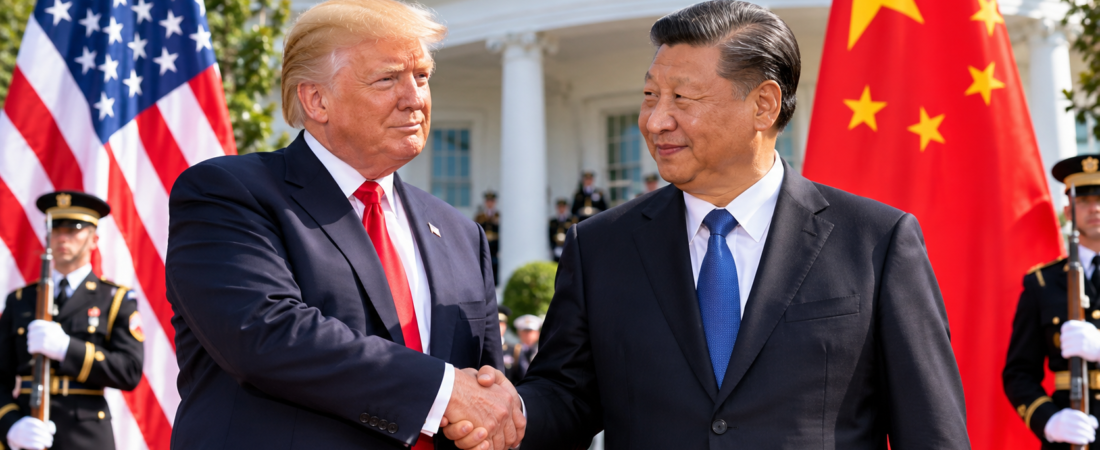
President Donald Trump welcomed Chinese President Xi Jinping to the White House on Thursday for one of the most closely watched diplomatic meetings of the year. The ceremony was elaborate. Xi’s arrival included full military honors, American and Chinese flags, military bands and a flyover. But behind the pageantry lies a much more difficult reality: the United States and China remain locked in a long-term competition over trade, technology, military power and global influence. The two leaders are not meeting simply to improve appearances. Both countries have reasons to prevent their rivalry from becoming more dangerous.
What Happened
Xi arrived in Washington on Wednesday for a state visit running from September 23 to 25. It is his first visit to Washington in more than a decade and his second meeting with Trump this year. Trump personally greeted Xi at Joint Base Andrews before Thursday’s formal White House welcome.
The summit comes during a period of relative calm in the economic relationship. Washington and Beijing have stepped back from some of the trade confrontation that previously threatened to escalate, but many of the underlying disputes remain unresolved. Trade is only part of the agenda. Taiwan, artificial intelligence, advanced technology, rare-earth minerals and China’s relationship with Iran are also expected to feature prominently in the talks.
Why This Meeting Matters
Few relationships have greater consequences for the global economy than the one between Washington and Beijing. The United States and China are the world’s two largest economies. Their companies and consumers are tied together through enormous flows of goods, technology, investment and raw materials.
At the same time, the two governments increasingly view each other as strategic competitors. Washington is concerned about China’s growing technological and military capabilities, while Beijing objects to American restrictions on advanced technology and U.S. security relationships in Asia.
That creates an unusual relationship: the two countries compete intensely yet remain economically connected. Neither side can easily separate from the other without significant costs.
Trade and Rare Earths Remain at the Center
Trade remains one of the biggest areas of negotiation. The United States wants China to purchase more American products and maintain reliable supplies of rare earths and other critical minerals. These materials are essential for industries ranging from automobiles and electronics to aerospace and defense. China, meanwhile, wants Washington to ease restrictions that limit Chinese access to advanced American technology.
This gives both countries leverage. The United States remains a major market and a leader in critical technologies. China holds an enormously important position in global manufacturing and the processing and supply of many critical minerals. The question is whether that mutual dependence encourages compromise—or simply becomes another weapon in the competition.
Taiwan: The Issue Neither Side Can Ignore
Taiwan remains one of the most sensitive subjects in U.S.–China relations. Beijing considers Taiwan part of China and strongly opposes American arms sales and other forms of support for the island. Washington maintains unofficial relations with Taiwan while continuing to provide defensive support under longstanding U.S. policy.
The dispute is much larger than Taiwan itself. Any serious confrontation in the Taiwan Strait could disrupt some of the world’s most important shipping routes and semiconductor supply chains. It could also draw the United States and China into a direct military crisis. For that reason, even when neither government changes its fundamental position, keeping communication open can matter.
Artificial Intelligence Becomes Part of the Rivalry
A newer issue has moved rapidly onto the agenda: artificial intelligence. The United States and China are competing to lead the next generation of AI technology. That competition increasingly touches national security, military capabilities and economic power.
At the same time, both governments have reasons to discuss the risks created by increasingly powerful AI systems. Officials have discussed the possibility of a U.S.–China dialogue dealing with serious AI-related incidents and common threats. That does not mean the technological rivalry is disappearing. It suggests that Washington and Beijing may see some value in establishing rules for managing a competition neither side expects to end soon.
Iran Adds Another Complication
The war involving Iran has added another difficult issue. China maintains important economic ties with Tehran and is the largest buyer of Iranian oil. Washington would like Beijing to use its economic influence to put greater pressure on Iran. Whether China is willing to do so remains uncertain.
For Beijing, Iran is both an economic partner and part of a broader strategy of maintaining relationships across the Middle East. For Washington, China’s relationship with Tehran has become increasingly connected to American security concerns.
Who Benefits or loses?
A more stable U.S.–China relationship could benefit businesses, farmers and consumers in both countries by reducing uncertainty surrounding tariffs, supply chains and access to critical materials. Countries elsewhere could benefit as well. Many nations trade extensively with both the United States and China and have little interest in being forced to choose between them.
But competition will continue. American and Chinese technology companies are fighting for global markets. Manufacturers are reconsidering where they build products. Governments across Asia are strengthening security relationships while simultaneously trying to maintain economic ties with China. The summit may calm some immediate disputes, but it will not erase those larger forces.
What Happens Next
The most important measure of this summit will not be the ceremony at the White House. It will be what happens afterward. If Washington and Beijing can extend their economic understandings, maintain the flow of critical minerals and establish regular communication on issues such as AI, the meeting could provide another period of stability.
If those arrangements break down, tariffs, technology restrictions and geopolitical tensions could quickly return to the center of the relationship. Trump and Xi do not need to become allies for this summit to matter.
The United States and China are likely to remain competitors for years to come. The larger question is whether they can manage that competition without allowing every disagreement to become a crisis. For the rest of the world, that may be the most consequential issue of all.
The Wider Chronicle