
September 25, 2026 | The Wider Chronicle
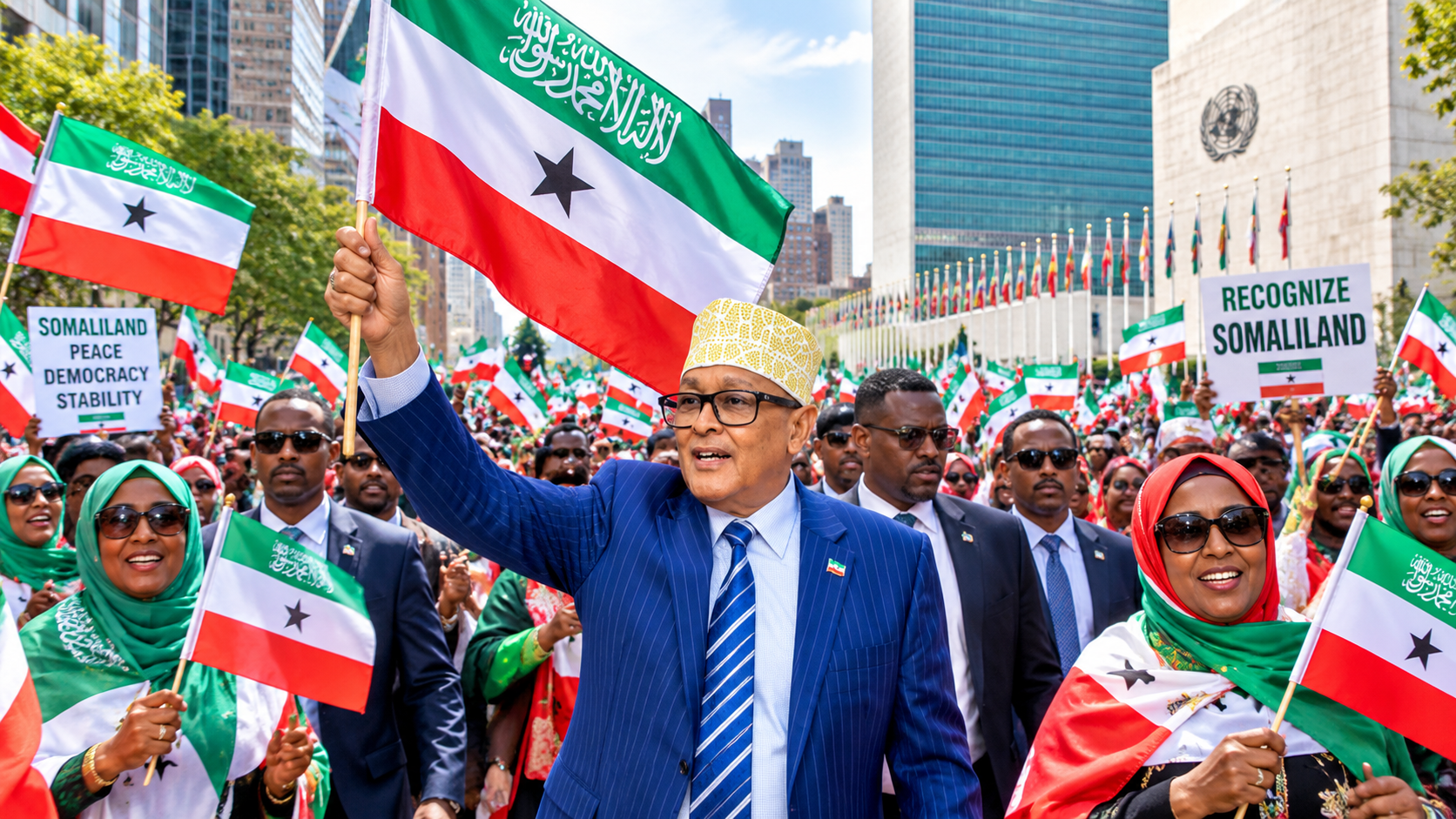
Thousands of Somaliland supporters gathered across from the United Nations headquarters in New York this week, carrying flags and delivering a message they have repeated for more than three decades: Somaliland wants international recognition. The timing could hardly have been more deliberate. World leaders, foreign ministers and diplomats were in New York for the high-level week of the United Nations General Assembly, giving Somaliland an unusually visible stage from which to make its case.
But behind the flags, speeches and photographs was a more difficult reality. The demonstration took place outside the United Nations at Dag Hammarskjöld Plaza. It was not an official UN meeting on Somaliland, there was no General Assembly vote on Somaliland’s status, and the gathering itself did not change Somaliland’s standing within the organization. That distinction tells a much bigger story: Somaliland has become increasingly successful at attracting attention to its campaign, but it has not yet converted that attention into the broad diplomatic support necessary to transform its international status.
A Powerful Symbol, but Not a Diplomatic Breakthrough
Somaliland officials did not hide the purpose of the New York gathering. The rally brought together members of the Somaliland diaspora from the United States and Canada, government officials and other supporters of recognition. Somaliland’s representative in the United States, Bashir Goth, had publicly encouraged supporters to attend and said organizers had secured a permit for the demonstration.
Somaliland officials used the occasion to repeat the territory’s historical argument for independence. Their case rests partly on the fact that the former British Somaliland protectorate became independent on June 26, 1960, before voluntarily uniting several days later with the former Italian-administered Somalia. Somaliland’s government argues that its 1991 declaration therefore represented the restoration of an earlier sovereignty rather than the creation of an entirely new state.
The message in New York was clear: Somaliland believes its history, institutions and decades of separate administration justify international recognition. But recognition is not determined by the size of a demonstration. It is ultimately decided by governments, and that is where Somaliland’s campaign continues to face its greatest obstacle.
The Diplomatic Wall Somaliland Has Not Broken
For years, Somaliland has presented itself as an exception in the Horn of Africa. It has established its own government institutions, security forces and political system and has operated separately from the federal government in Mogadishu for more than three decades. Those realities form the foundation of Somaliland’s argument that it should be treated as a sovereign state.
The international system, however, operates on another reality as well: Somalia is already a recognized sovereign state and a member of the United Nations. That gives Mogadishu a significant diplomatic advantage. Countries considering Somaliland’s claim are not simply being asked whether Somaliland possesses functioning institutions. They are being asked whether they are prepared to recognize as an independent country territory that the internationally recognized government of Somalia considers part of its sovereign territory.
For many governments, particularly in Africa, that is a much more complicated decision.
The African Union Problem
Perhaps the biggest obstacle to Somaliland’s recognition campaign is not in New York at all, but in Addis Ababa. The African Union continues to support Somalia’s sovereignty, unity and territorial integrity and has opposed moves toward unilateral recognition of Somaliland.
The dispute involves one of the most sensitive principles in post-colonial Africa: the preservation of borders inherited at independence. African governments have historically approached territorial changes cautiously because of concerns that reopening colonial-era borders could encourage numerous separatist disputes across the continent.
Somaliland argues that its situation is different. Its supporters point to the former British Somaliland’s brief period as an independent state in June 1960 before its union with the former Italian-administered territory. From Somaliland’s perspective, it is not attempting to redraw an African colonial border but to restore the sovereignty of a territory that had already achieved independence.
That argument has not persuaded the African Union to support Somaliland’s recognition. As long as Africa’s principal continental organization remains committed to Somalia’s territorial integrity, Somaliland faces a formidable diplomatic barrier. A large demonstration in New York can bring international attention to the issue, but it cannot by itself overcome that institutional opposition.
Recognition Is Not Something the UN Simply Grants
The New York rally also highlights an important distinction about the recognition process. The United Nations does not simply decide whether a territory should become a country. Recognition is primarily granted by individual states, while admission to the United Nations involves a separate process.
Under the UN Charter, an applicant seeking membership must receive a recommendation from the Security Council before the General Assembly can decide on admission. That makes the process intensely political. Somaliland would eventually need sufficient diplomatic support to navigate a Security Council in which the five permanent members — the United States, China, Russia, France and the United Kingdom — possess veto power.
The real battle for Somaliland’s international status, therefore, is unlikely to be decided on the pavement outside UN headquarters. It will be fought through diplomacy inside foreign ministries, presidential offices, parliaments and international organizations.
Israel Changed the Conversation
Somaliland’s diplomatic situation changed significantly after Israel recognized Somaliland in December 2025. For Hargeisa, the decision represented an important breakthrough because Somaliland could finally point to formal recognition by a UN member state after decades of campaigning.
But what followed was equally significant. Israel’s decision did not immediately produce a broad wave of recognition from other governments. Instead, it generated strong opposition from Somalia and regional organizations, including the African Union, which reaffirmed its support for Somalia’s sovereignty and territorial integrity.
Israel’s decision therefore opened a diplomatic door, but it did not resolve Somaliland’s larger problem. The crucial question is whether additional governments will eventually follow. Until that happens on a meaningful scale, Somaliland’s recognition remains limited despite the political significance of Israel’s decision.
Washington May Matter More Than New York
The most consequential part of Somaliland’s American diplomatic campaign may ultimately take place away from the rally itself. Somaliland officials have increasingly sought political relationships in Washington and have emphasized the territory’s strategic importance along the Gulf of Aden, its proximity to the Bab al-Mandab shipping route and the potential importance of Berbera to regional security and international commerce.
This represents an evolution in Somaliland’s diplomatic argument. For years, much of its case centered on history, democratic institutions and its relative stability compared with other parts of Somalia. Those arguments remain important, but Somaliland is increasingly presenting itself as a potentially valuable strategic partner for major powers.
That may explain why Washington matters so much to the campaign. A change in U.S. policy could alter diplomatic calculations elsewhere, but meetings with supportive American lawmakers or officials should not be confused with formal recognition by the United States. The important measurement is not simply who meets Somaliland’s leaders, but whether those meetings eventually produce a change in government policy.
The Question Behind the New York Rally
This brings the investigation back to the people standing outside the United Nations. The rally clearly demonstrated political commitment. Somalilanders traveled to New York, officials participated, flags filled the plaza and the gathering placed Somaliland’s recognition campaign in front of an international audience during one of the busiest diplomatic periods of the year.
Those are meaningful achievements for a public advocacy campaign, but diplomacy requires a different measurement. Which governments changed their positions? What new recognition was secured? What commitments were obtained from major powers? What changed within the international system because of the gathering?
Those questions are not an argument against the people who participated in the rally. They are questions that should be asked of any government conducting an international diplomatic campaign. Visibility can help a cause, but visibility and diplomatic recognition are not the same thing.
Who Organized and Paid for the Campaign?
The New York gathering also raises a legitimate question about transparency. Public information identifies Somaliland’s representative in the United States, Bashir Goth, as playing a role in promoting and organizing the recognition rally and encouraging diaspora participation. Somaliland government officials participated in the event, and the government subsequently publicized the gathering.
What remains unclear from the publicly available information is exactly how the wider effort was financed. Who paid for event organization? Were public funds used for any portion of the campaign? Did diaspora organizations pay for transportation or other expenses? Were private donors involved? What was the total cost associated with the Somaliland delegation’s wider diplomatic campaign in the United States?
The Wider Chronicle has not found reliable public documentation establishing the answers to those questions. That does not prove that government money financed the rally, nor does it prove that private donors or diaspora organizations paid for it. It simply means the publicly available evidence does not yet provide a complete financial picture.
That distinction is important in investigative reporting. Questions about public spending should be answered with documents, invoices, budget records or direct disclosures rather than assumptions. If such records become available, they could provide a clearer picture of how Somaliland’s international recognition campaign is being financed.
Somaliland’s Real Challenge
The images from New York may eventually become part of the history of Somaliland’s long campaign for recognition, but they also illustrate how difficult the remaining diplomatic journey is. Somaliland has demonstrated that it can mobilize supporters abroad, gain the attention of politicians, cultivate international relationships and present itself as a strategic partner. Israel’s recognition also showed that the diplomatic status quo is not necessarily permanent.
Yet the central obstacles remain. Somalia continues to possess broad international recognition, the African Union continues to support Somalia’s territorial integrity, and Somaliland has not secured the widespread recognition that would fundamentally change its international position.
None of this determines what will happen in the future. Diplomatic positions can change, alliances shift and governments reassess their interests. But if Somaliland wants to move from a long-running recognition campaign toward broadly recognized statehood, public demonstrations alone will not accomplish that objective.
The decisive conversations will happen away from the crowds, as governments weigh regional security, trade, international law, strategic interests and their relationships with Somalia and Somaliland.
The New York rally succeeded in putting Somaliland’s flag at the doorstep of the United Nations. The harder task is convincing enough governments to open the diplomatic door.
The Wider Chronicle