
← Somali Heritage Museum · All collections
COASTAL CITIES & TRADE
Old Mogadishu: Streets That Open to the Sea
Architecture, maritime connections, and a living coastal heritage.
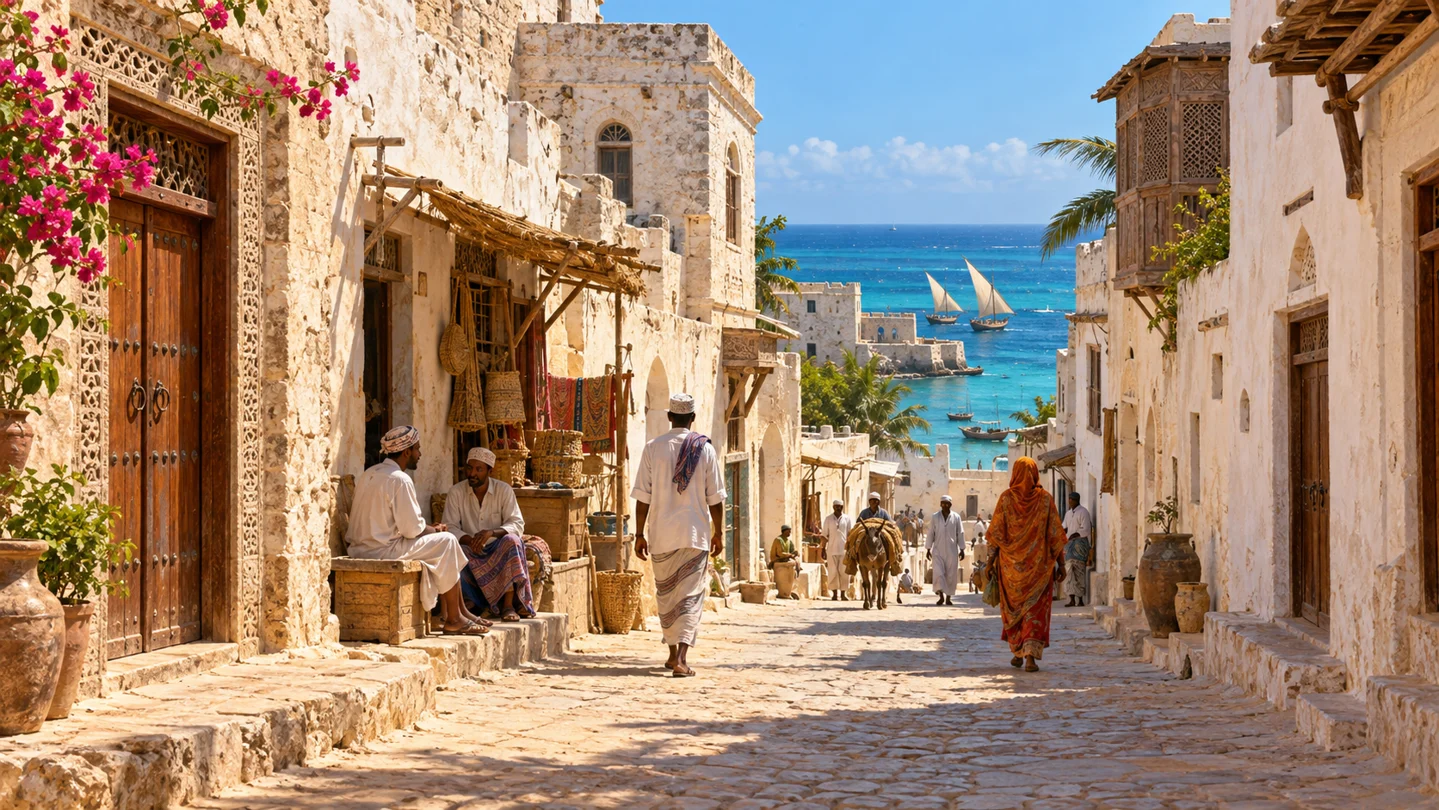
- Name / subject
- Muqdisho; historic coastal neighbourhoods
- Place / community
- Mogadishu, Somalia
Reading the image
A narrow passage between pale buildings leads the eye toward the Indian Ocean. Textured walls and wooden doors bring the view down to the scale of a person walking through a neighbourhood. This is an interpretive streetscape inspired by Mogadishu’s coastal heritage. It is not a photograph of a named street, and the arrangement of buildings is not a reconstruction of a verified historical plan.
A city made of many histories
UNESCO describes Old Mogadishu through its mosques, coral stone houses, markets, and continuing traditions. These elements invite us to see the city as more than a skyline. Streets and buildings carry evidence of daily work, worship, movement, and exchange. Different buildings belong to different periods, so the view should not be labelled as though all of its architecture came from one moment in history.
The coast as a connection
Mogadishu’s heritage includes the relationships created through maritime travel. UNESCO’s work on the Secondo-Lido Lighthouse and surrounding Old Town places pre-colonial trade networks, Islamic heritage, colonial buildings, and later urban change within a layered landscape. The lighthouse offers one documented example of how a waterfront structure can connect navigation with a wider history of people and places. Our image does not attempt to depict that landmark.
Heritage is also everyday life
The people who live in historic districts are part of their heritage. UNESCO’s 2026 reporting describes pressures from flooding and rapid urban change, including drainage problems affecting homes, businesses, roads, and older buildings. This means preservation cannot be measured only by the condition of a monument. A street must also work for the people who use it, and conservation decisions need to take their daily needs seriously.
Protecting a neighbourhood’s story
UNESCO’s work emphasises documentation, community participation, planning, and coordination. Earlier assessments of the lighthouse brought structural engineers, conservation architects, and Somali heritage professionals together to consider stabilisation and longer-term protection. These efforts help explain why careful records matter. A measured plan, a dated photograph, and a resident’s account can each preserve a different part of the same place.
Look beyond the postcard
The illustration is an invitation to explore, while the source records provide the evidence. Notice the route through the buildings and the relationship between shade, walls, and open water. Then imagine the view with people going about their day. Old Mogadishu belongs in a museum because it holds stories of architecture and exchange, but also because it remains a place where people live and make new memories.
← Back to all collections