
← Somali Heritage Museum · All collections
POETRY, MUSIC & ORAL HERITAGE
Sayyid Mohamed Abdulle Hassan: Poetry in English
A voice of resistance, faith, and remembrance.

A poet and Dervish leader
Sayyid Mohamed Abdulle Hassan joined poetry to the struggle against colonial rule. His verse addressed political opponents and supporters, but it also expressed religious devotion and personal feeling. Reading these different subjects together reveals a voice that reached beyond the battlefield.
“Koofil” — The Death of Richard Corfield
This poem addresses the British commander Richard Corfield, killed fighting the Dervishes in 1913. The speaker imagines the dead commander reporting his defeat in the next world. Its force comes from direct address: an enemy becomes the imagined witness to Dervish victory.
“You have died, Corfield, and are no longer in this world,
a merciless journey was your portion.”
Short English excerpt; translation attributed to B. W. Andrzejewski by the linked source.
Explore more poems in English
Lidwien Kapteijns’s 1996 study, “Proclaim to the People”: Five Poems, presents Somali texts alongside English translations. The selection includes political admonitions, thanksgiving for his wife’s recovery, and a reflection on his life’s work. Reading the languages side by side offers a fuller encounter with the poetry.
POETRY, MUSIC & ORAL HERITAGE
The Spoken Archive: Stories Between Generations
How voice, listening, and memory become a form of heritage.
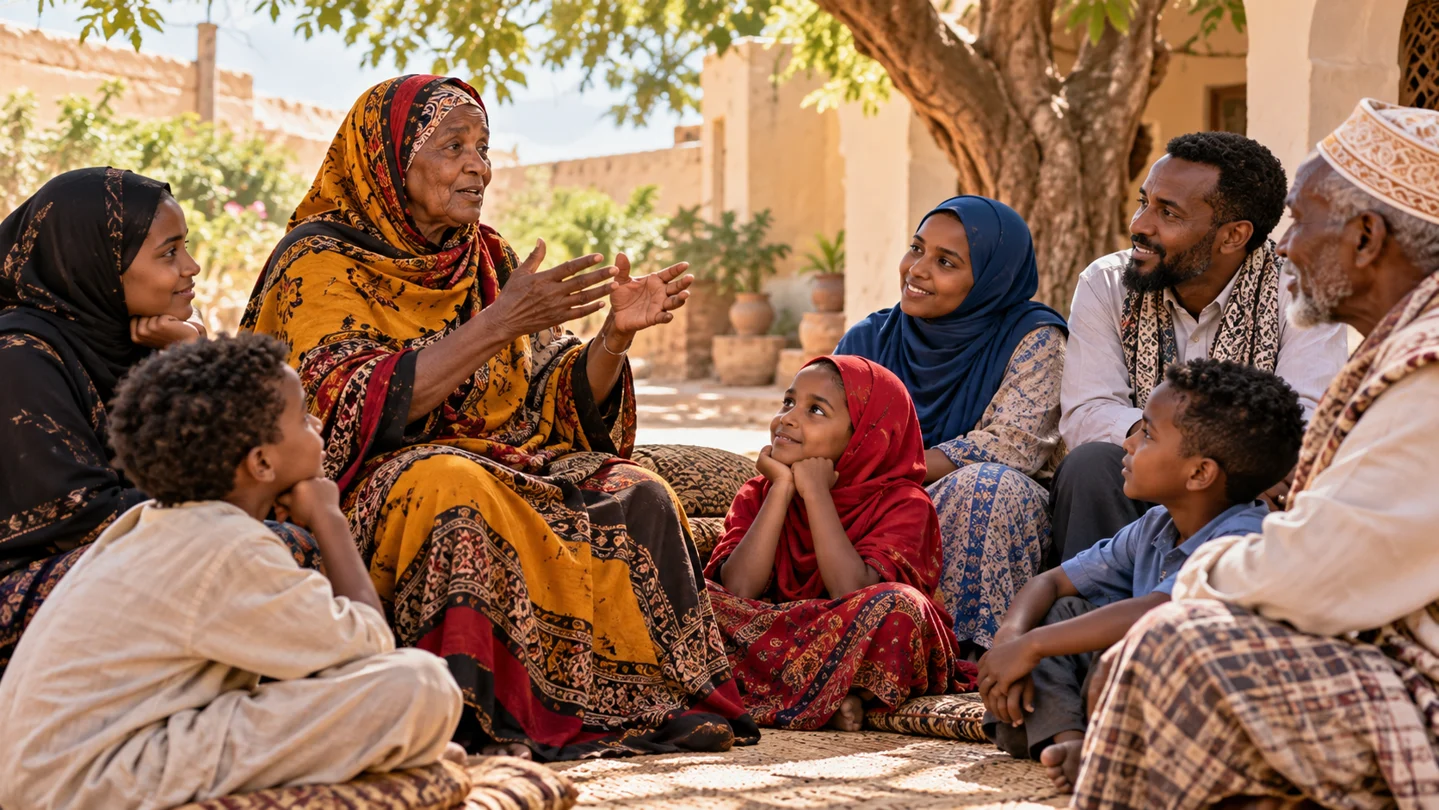
- Name / subject
- Somali oral heritage; forms include poetry, proverbs, song, and folktales
- Place / community
- Somali communities in the Horn of Africa and diaspora
Reading the image
The scene centres on an older storyteller and the people listening to her. Her gestures and the listeners’ attention make the exchange itself the subject. No real person or documented gathering is represented. The illustration offers a way to think about transmission: a story moves between people through speech, attention, and memory.
Heritage that lives in performance
A poem on a page preserves words, but a voice also carries timing, emphasis, melody, and feeling. UNESCO’s work with Somali cultural institutions highlights poetry, song, and dance as continuing means of passing on heritage. Oral traditions therefore belong in a museum alongside objects and buildings. Their preservation asks us to pay attention to a performance and its setting, as well as to the words themselves.
Women as carriers of knowledge
A panel activity listed by UNESCO on Somali women’s role in oral traditions identifies lullabies, proverbs, poetry, and folktales as forms women have helped keep alive. The woman at the centre of our illustration reflects that theme without claiming to portray a particular practitioner. The image also directs attention to the listeners: transmission depends on people receiving knowledge as well as people sharing it.
From a gathering to a recording
The Radio Mogadishu archive shows another way voices can travel across generations. UNESCO describes recordings that include music, speeches, drama, literature, sport, and other moments in Somalia’s modern history. Families and performers once encountered these voices through broadcasts; recordings now offer younger listeners a way to hear earlier cultural life. Magnetic tape, however, is vulnerable to age, humidity, and damage, making assessment and digitisation essential to preservation.
One tradition is not every tradition
Somali oral heritage contains different forms and community practices. Xeer Ciise, recorded by UNESCO for Somali-Issa communities in Ethiopia, Djibouti, and Somalia, offers a specific example of knowledge transmitted through forms including tales, proverbs, games, and poetry. It should be understood in that community context. Our general storytelling image does not depict a Xeer Ciise proceeding, a named poem, or an identifiable ceremony.
Keeping the voice with its story
A useful recording needs context: who is speaking, where and when it was recorded, what language is used, and what permission allows it to be shared. Translation helps new audiences, while keeping the original preserves expression that another language may not fully convey. In this collection, a voice should remain connected to its speaker and community. Look again at the listening faces: the future of a spoken tradition begins when someone chooses to hear it.
← Back to all collections