
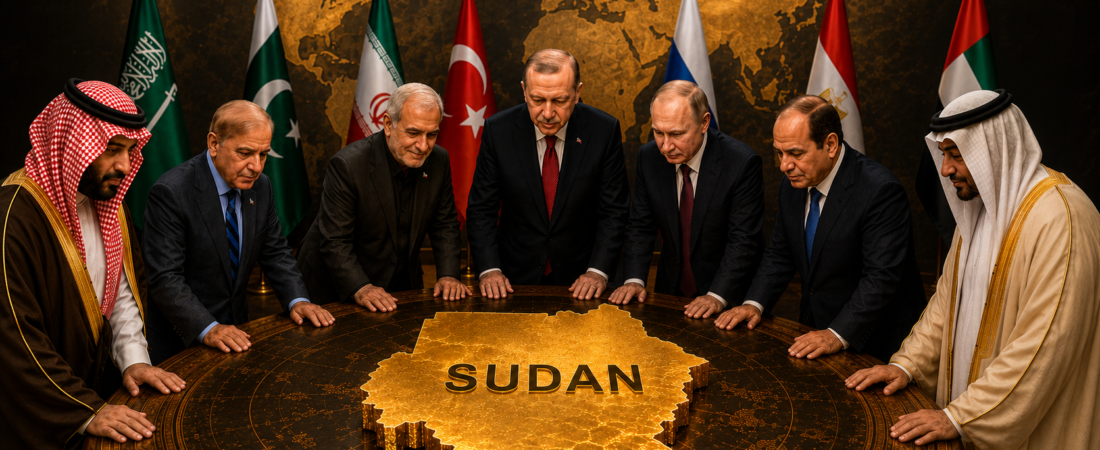
When Sudan’s war appears in international headlines, it is usually described as a struggle between two rival generals: General Abdel Fattah al-Burhan, commander of the Sudanese Armed Forces, and Mohamed Hamdan Dagalo widely known as Hemedti leader of the paramilitary Rapid Support Forces.
That description is accurate, but incomplete.
The conflict began in April 2023 following the collapse of an uneasy partnership between the army and the RSF. The two forces had cooperated in removing President Omar al-Bashir in 2019 and overthrowing Sudan’s civilian-led transitional government in 2021. They later turned against each other over control of the state, the military and Sudan’s economic resources.
What started as a Sudanese power struggle has since become entangled with the interests of foreign governments, weapons suppliers, commercial networks and regional powers. Sudan’s strategic position on the Red Sea, its agricultural land and its enormous gold resources have made the country a prize in a much wider geopolitical contest.
The United Arab Emirates and the RSF
The United Arab Emirates has faced the most serious accusations of supporting the Rapid Support Forces.
Reports and investigations have alleged that weapons and military equipment reached the RSF through neighboring countries, particularly Chad and Libya. Sudan’s government has also accused the UAE of financing foreign mercenaries fighting with the RSF.
The UAE has repeatedly and categorically denied supplying weapons or mercenaries to either side. It says its activities in the region are humanitarian and that the accusations are attempts by Sudan’s military authorities to distract attention from their own responsibility for the war.
The relationship is also connected to gold. The RSF and businesses associated with its leadership developed extensive interests in Sudan’s gold industry before the war. The UAE has long been an important destination and trading center for Sudanese gold, making the commercial relationship surrounding the conflict especially significant.
Egypt and the Sudanese Army
Egypt has traditionally maintained close relations with the Sudanese Armed Forces and views the army as Sudan’s legitimate national institution.
Cairo’s concerns extend beyond friendship with General al-Burhan. Egypt wants stability along its southern border and is deeply concerned about the Nile, regional security and the possibility that Sudan could fragment into territories controlled by competing militias.
Egypt has been widely described as politically and militarily aligned with the Sudanese army. For Cairo, the survival of a centralized Sudanese state is preferable to an unstable neighbor dominated by armed factions.
Iran’s Return to Sudan
Iran restored diplomatic relations with Sudan after years of separation and emerged as an important military partner of the Sudanese army.
Iranian-made drones reportedly strengthened the army’s ability to strike RSF positions and contributed to its recovery of territory. For Iran, Sudan offers more than an arms market. A relationship with Khartoum could provide Tehran with greater influence near the Red Sea one of the world’s most important commercial and strategic waterways.
For the Sudanese army, Iranian drones provided a relatively inexpensive way to challenge the RSF’s control of territory. For Iran, the relationship created another opportunity to expand its regional influence.
Turkey and Military Technology
Turkey has also developed close relations with Sudan’s military establishment.
Documents examined by The Washington Post indicated that the Turkish company Baykar supplied the Sudanese army with drones and missiles worth at least $120 million. The investigation also reported discussions involving access to Sudanese minerals and strategic positions on the Red Sea.
Turkish support reflects Ankara’s wider ambition to increase its political, commercial and military presence in Africa. Sudan offers agricultural opportunities, mineral resources and access to the Red Sea.
Russia, Wagner and Sudanese Gold
Russia’s involvement in Sudan is closely tied to gold and its search for strategic influence in Africa.
Networks connected to the Wagner Group established relationships with Sudanese gold companies and political leaders before the present war. Gold offered a source of revenue that could operate outside conventional Western-controlled financial systems.
Russia’s position has not always been straightforward. Different Russian networks have maintained contacts with both the RSF and the Sudanese army. The United States has accused Russia of financing or assisting both sides while using Sudan’s gold industry to advance its strategic objectives. Russia has rejected those allegations.
Moscow has also pursued the possibility of establishing a naval facility on Sudan’s Red Sea coast. Such a base would give Russia access to a vital maritime corridor connecting the Indian Ocean, the Middle East and Europe.
Libya and the Supply Routes
Eastern Libya has reportedly served as an important logistical corridor for assistance reaching the RSF.
Forces commanded by Libyan military leader Khalifa Haftar have been accused of facilitating fuel, weapons or other supplies across the border. Haftar’s representatives have denied supporting either side.
Libya’s role demonstrates how Sudan’s conflict is connected to a broader network of armed groups and contested territories stretching across the Sahel, North Africa and the Horn of Africa.
Pakistan and the Expanding Arms Market
Pakistan has also emerged as a potential supplier to Sudan’s army.
In January 2026, Reuters reported that Pakistan was approaching a $1.5 billion agreement to provide the Sudanese army with aircraft, drones and air-defense equipment. Possible Saudi financing or facilitation was discussed, but that involvement remained unconfirmed.
The reported agreement illustrates how Sudan’s war has become an international market for drones, aircraft, ammunition and military technology.
Saudi Arabia and the United States
Saudi Arabia and the United States have mainly presented themselves as mediators rather than military sponsors.
Together, they hosted negotiations in Jeddah intended to produce ceasefires and protect civilians. However, repeated agreements failed to stop the fighting.
Saudi Arabia has strong reasons to prevent Sudan’s collapse. Instability across the Red Sea threatens maritime security, trade routes and Saudi economic projects. Nevertheless, diplomatic influence has so far proved insufficient to persuade either side to end the war.
The United States has employed negotiations and sanctions against figures and companies connected to both belligerents. Yet sanctions and diplomatic pressure have not stopped weapons, money and commercial resources from sustaining the conflict.
Sudan Is More Than a Proxy War
Foreign involvement should not erase the responsibility of Sudan’s own commanders. The army and the RSF chose to fight, and forces on both sides have been accused of indiscriminate attacks and serious violations against civilians.
But outside involvement has made the war more difficult to end.
Every shipment of weapons gives one side reason to believe that military victory remains possible. Every foreign sponsor, commercial network and smuggling route helps keep the machinery of war operating. Gold extracted from Sudan can finance weapons that return to Sudan, creating a deadly cycle in which the country’s own wealth contributes to its destruction.
Sudan is therefore not simply the site of a civil war between two generals. It has become an arena where foreign powers compete for gold, military influence, agricultural land, Red Sea access and regional dominance.
The Sudanese people are paying the price.
Until the international networks supplying weapons and financing are confronted and until Sudan’s leaders place civilian life above military power the war behind Sudan’s war will continue.