When most people hear the words African slave trade, their minds immediately turn westward to ships crossing the Atlantic, plantations in the Americas, and millions of Africans carried into slavery in the New World.
But on the opposite side of the continent, another vast system of human trafficking existed for centuries.
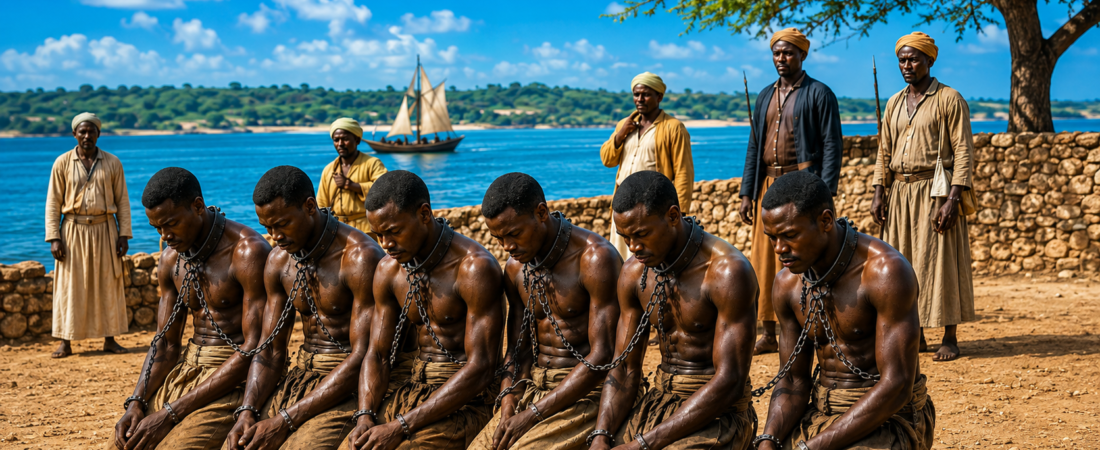
From the interior of East and Central Africa, enslaved men, women, and children were marched toward the Indian Ocean coast. From ports such as Bagamoyo and especially Zanzibar, many were transported across the sea toward Arabia, the Persian Gulf, India, and islands of the Indian Ocean. Others remained enslaved within East Africa itself.
It is one of the darkest chapters of African history and one that receives far less attention than the Atlantic slave trade.
A Trade Across the Indian Ocean
Trade between East Africa and lands surrounding the Indian Ocean existed long before the nineteenth century. The Swahili Coast became part of a commercial world connecting Africa with Arabia, Persia, India and beyond.
People were among the commodities caught within these networks.
Over time, however, the trade in enslaved Africans expanded dramatically. By the eighteenth and nineteenth centuries, Zanzibar had emerged as one of the most important commercial centers on the East African coast.
Under Omani influence, Zanzibar became deeply connected to the trade in ivory, cloves and enslaved people. The growth of plantation agriculture particularly clove plantations on Zanzibar and Pemba created enormous demand for forced labor.
The Long March to the Coast
For many victims, the nightmare began hundreds of miles from the ocean.
People were captured or acquired in regions stretching deep into what are today Tanzania and the Democratic Republic of Congo and surrounding areas. They were then forced into caravans traveling toward the coast.
One documented route stretched approximately 1,200 kilometers from Ujiji on Lake Tanganyika to Bagamoyo, opposite Zanzibar. Captives could be chained together and compelled to walk hundreds of kilometers before ever reaching the sea.
Bagamoyo became one of the great mainland terminals of this system.
From there, many captives crossed the water to Zanzibar.
For countless people, therefore, slavery was not simply an ocean voyage. It began with capture, separation from family and community, followed by an exhausting journey across the African interior.
Zanzibar: The Center of the Trade
By the nineteenth century, Zanzibar occupied a central position in East Africa’s slave economy.
Its location connected the African mainland with the wider Indian Ocean world. UNESCO describes Zanzibar as one of East Africa’s principal slave trading ports and notes its later symbolic importance in the campaign to suppress the trade.
The scale became particularly large during the nineteenth century. UNESCO’s historical documentation indicates that by the middle of that century, more than 20,000 enslaved people were being imported into Zanzibar, with roughly half absorbed by the islands’ clove plantations, others sent to parts of the East African coast, and others transported northward.
This is important because the East African slave trade was not simply a story of Africans being exported overseas.
Large numbers remained within East Africa, working on plantations and in other forms of forced labor.
Where Were They Taken?
Those transported beyond the East African coast entered a commercial network very different from the Atlantic system.
Enslaved Africans were carried toward destinations including Arabia, Persia, India, Mauritius, Réunion and other parts of the Indian Ocean world.
Their labor and circumstances varied enormously. Some worked on plantations. Others became domestic servants, agricultural workers, sailors or laborers.
The system therefore cannot be reduced to a single route or destination.
It was a web connecting the African interior, the Swahili Coast and societies across the Indian Ocean.
Why Is It Less Remembered?
The Atlantic slave trade occupies an enormous place in global historical memory, particularly because of its scale, its connection to European colonial expansion and the Americas, and its lasting relationship with racial systems that shaped societies such as the United States, Brazil and the Caribbean.
The East African and Indian Ocean slave trades left a different historical footprint.
There was no single destination equivalent to the plantation societies of the Americas. Enslaved Africans were dispersed across numerous regions and incorporated into different societies.
That does not make their experience less important.
It simply means their history is more geographically scattered and therefore easier for the wider world to overlook.
The End Did Not Come Overnight
During the nineteenth century, Britain increasingly pressured the rulers of Zanzibar to restrict the slave trade.
A major turning point came in 1873, when Sultan Barghash of Zanzibar signed a treaty under British pressure that closed the slave market and prohibited the maritime slave trade.
But legislation did not instantly eliminate slavery or trafficking. UNESCO notes that illegal trading continued secretly afterward.
Today, the Anglican cathedral in Stone Town stands on the site associated with Zanzibar’s former slave market a physical reminder of the people who passed through this system.
A History Worth Remembering
Remembering the East African slave trade is not about competing with the history of Atlantic slavery or deciding which tragedy deserves greater attention.
Both belong to the history of Africa.
The Atlantic trade carried millions westward. The Indian Ocean networks carried Africans eastward and northward, while many others remained enslaved within Africa itself.
Together, these histories reveal something larger: Africa’s experience with slavery cannot be understood by looking in only one direction.
Across forgotten caravan routes, old coastal ports and the narrow streets of Zanzibar are traces of people whose lives were uprooted and whose stories rarely entered the world’s popular memory.
They deserve to be remembered.
The slave trade did cross the Atlantic. It crossed the Indian Ocean too and East Africa still carries its history.
Excerpt
For centuries, enslaved Africans were marched from the interior of East Africa to coastal ports and transported across the Indian Ocean to Arabia, Persia, India and beyond. This is the story of the East African slave trade a history too often forgotten.