
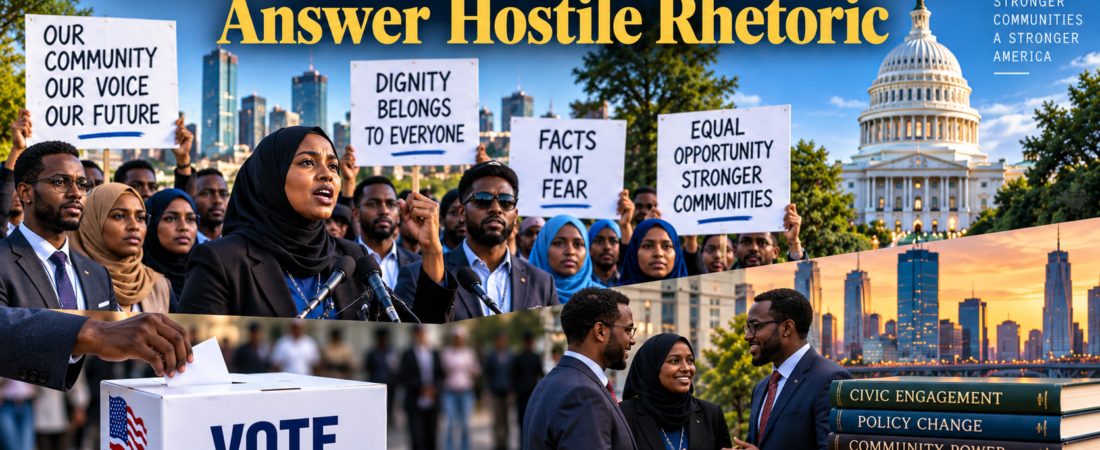
The intersection of money, media, and minority rights frequently places marginalized communities at a severe disadvantage during election seasons. Under federal regulations, specifically the Federal Communications Commission (FCC) Section 315(a) “No Censorship” rule, local television and radio stations are legally required to broadcast campaign advertisements exactly as submitted by a qualified candidate. Even if an advertisement contains broad generalizations or derogatory themes targeting an entire ethnic demographic such as advertisements referencing “Somali fraud” in Minnesota station managers are prohibited from editing or refusing the content.
This legal reality means that the system protects the right to speak, but it does not guarantee an equal microphone. When a wealthy political campaign commands millions of dollars to blast divisive rhetoric across the airwaves, a targeted community cannot look to the courts or the government for a quick fix. Instead, they must deploy the exact same constitutional weapon used against them: the First Amendment.
Across the United States, targeted communities have repeatedly demonstrated that while they may not own the TV stations, they possess the numbers, organization, and voting power required to alter the political calculus.
Phase 1: Overwhelming the Narrative with “More Speech”
In American constitutional law, the standard remedy for offensive speech is not forced silence it is more speech. When a political campaign targets a community to rally its base, grassroots organizations immediately move to disrupt the candidate’s public narrative through aggressive public relations strategies.
- Forcing Public Accountability: Civil rights groups and local leaders use coordinated press conferences, community town halls, and local media appearances to confront the rhetoric directly. By showing the public the real-world impact of these advertisements such as heightened security concerns for local business owners or the bullying of school children the community shifts the debate from an abstract discussion about government fraud to a concrete issue of community safety and basic human dignity.
- Media Pressure and Shaming: While the FCC forces television stations to run candidate ads, it does not protect the candidate’s campaign donors or the private platforms hosting their digital content. Communities frequently organize digital boycotts, flooding the phone lines and social media pages of corporate donors who fund the divisive campaigns. When corporations face the threat of a public relations crisis, they often pull their financial backing, effectively starving the offensive campaign of the fuel it needs to stay on the air.
Phase 2: Pooling Resources to Build a Mirror Microphone
Because individual citizens rarely have the financial leverage to match a major political campaign, communities utilize collective economic power to buy their own media presence.
- Political Action Committees (PACs): By forming localized political action committees, thousands of working-class citizens can pool small donations ($5, $10, or $20) into a significant campaign war chest. These community funded PACs can buy their own television, radio, and digital advertisements to air powerful counter messages.
- Controlling the Message: These counter advertisements do not just play defense; they go on the offensive. They highlight the community’s economic contributions, profile local heroes, doctors, and teachers, and directly expose the targeting politician’s record on other critical issues like healthcare, education, and the economy. This neutralizes the attack ad by showing voters that the candidate is using a minority group as a distraction to hide their own legislative failures.
Phase 3: The Ultimate Equalizer — The Power of the Vote
A politician’s primary objective is to win an election. The most definitive way a community can punish a candidate who targets them is by turning out to vote in numbers so overwhelming that it makes divisive campaign strategies a mathematical liability.
- Massive Voter Mobilization: The presence of an offensive ad often acts as a massive catalyst for voter registration. Grassroots groups launch intensive, door to door get out the vote (GOTV) campaigns, setting up registration booths outside community centers, mosques, and local markets. They provide translation services, transport voters to early voting locations, and ensure that every eligible member of the community understands exactly how to cast their ballot.
- Unifying the Voting Bloc: When an entire demographic votes as a unified bloc, they gain immense leverage, particularly in swing states or tightly contested local districts. If a politician realizes that attacking a specific community will trigger a 90% voter turnout against them from that group alongside support from sympathetic allies who reject divisive politics the strategy of using ethnic scapegoats becomes a losing formula.
- Running Their Own Candidates: The final stage of political maturity for any targeted community is moving from defending themselves to occupying the seats of power. Over the last decade, communities facing intense political scrutiny have consistently responded by running their own leaders for school boards, city councils, state legislatures, and Congress.
The Final Calculation
The American legal system leaves political campaigns wide open, permitting candidates to utilize sharp and offensive language. However, this openness is a two-way street. The law protects a candidate’s right to broadcast a divisive advertisement, but it completely protects a community’s right to organize, speak out, and completely dismantle that candidate’s political future.
In a democracy, a politician can buy airtime, but they cannot buy a victory. The ultimate judge of campaign rhetoric is not a federal bureaucrat, or a courtroom judge it is the voter standing in the ballot box on Election Day.
The Wider Chronicle — Go Beyond the Headlines.