
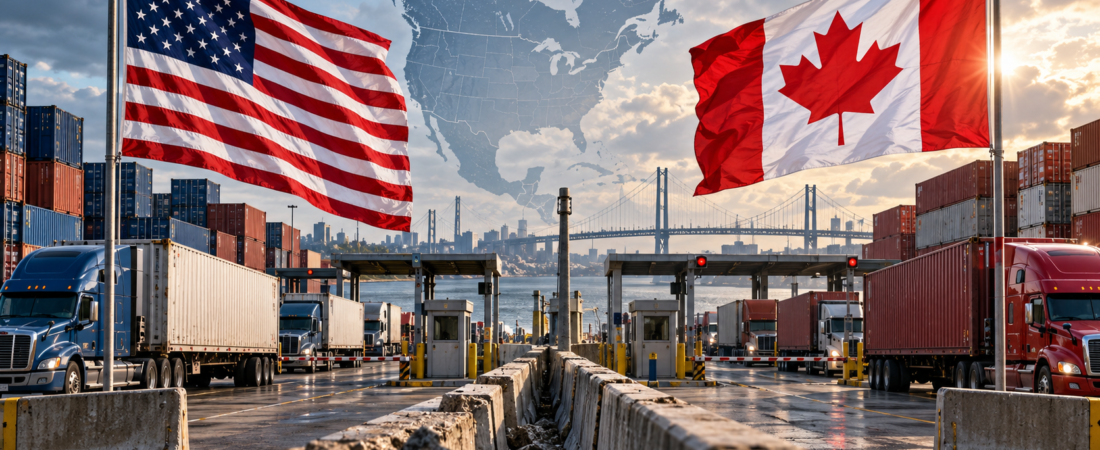
OTTAWA & WASHINGTON — The decades-long economic alliance between the United States and Canada suffered its most catastrophic rupture in modern history today. On September 8, 2026, Canada officially enacted $20 billion (C$27.6 billion) in retaliatory tariffs against the U.S., triggering immediate and severe import bans from Washington.
For a relationship often hailed as the world’s most successful bilateral partnership, the sudden descent into aggressive protectionism has left businesses, consumers, and economists scrambling to understand how the continent reached this breaking point.
⏱️ The Spark: When the Conflict Started
The immediate fuse for the current conflict was lit in late July 2026, when the U.S. administration unexpectedly announced sweeping 50% tariffs on Canadian steel, aluminum, and manufacturing inputs.
While trade friction between the two neighbors is not new historical disputes over lumber and dairy have flared for decades this escalation is fundamentally different:
- The Section 338 Maneuver: Washington invoked a Depression-era law (Section 338 of the Tariff Act of 1930).
- Bypassing the USMCA: This rare legal move effectively bypasses the United States-Mexico-Canada Agreement (USMCA).
- No Free-Trade Exemptions: By using this law, the U.S. legally stripped away the standard free-trade exemptions Canada usually enjoys.
Following a total collapse of bilateral emergency talks in mid-August, the conflict reached its point of no return today as Canada’s dollar for dollar retaliatory package officially went into effect.
🔍 The Root Causes: What is Driving the Standoff?
The conflict is not merely a disagreement over numbers; it is driven by two fundamentally incompatible economic philosophies and fierce domestic political pressures.
1. The U.S. Push for “Radical Decoupling”
The core driver from the American perspective is an aggressive nationalist economic strategy aimed at forcing manufacturing supply chains entirely back into the United States. The Trump administration argues that the U.S. has suffered from “discriminatory treatment” regarding its exports and that broad-based tariffs are the only weapon strong enough to break reliance on foreign production. This rhetoric has taken on an intensely nationalistic tone, symbolized by a recent executive order seeking to rename Lake Ontario to “Lake America.”
2. Canada’s Defensive Pivot to Independence
In Ottawa, Prime Minister Mark Carney’s government has reframed the trade war not as a dispute to be negotiated, but as a turning point for national sovereignty.
Canada is now actively attempting a historic, permanent pivot toward European and Asian trade relationships to structurally diversify its economy away from its southern neighbor.
3. Midterm Election Pressures
Domestic politics are heavily accelerating the timeline. The United States is heading into pivotal midterm elections in November 2026. The administration is betting that a hardline, protectionist stance will resonate with manufacturing heavy voting blocks. However, it is a high-stakes gamble:
- 20% of Americans currently approve of the trade friction, according to a recent Reuters/Ipsos poll, as fears mount over immediate retail inflation.
- 62% of Canadian voters approve of Carney’s aggressive retaliation, politically fortifying Ottawa’s resolve to dig in for a long fight.
📊 Economic Impact: Who is Hit?
The economic mechanics of the trade war are designed to inflict maximum pain on both sides of the border, targeting key industrial vulnerabilities.
+--------------------------------------------------------------------------+

|                       CROSS-BORDER SECTOR IMPACT                         |
+------------------------------------+-------------------------------------+

| CANADIAN TARIFFS (Active Now)      | U.S. COUNTERMEASURES (Sept 29)      |
+------------------------------------+-------------------------------------+

| • 15% to 50% duties on US goods    | • Total import bans on alcohol      |
| • Targets over 700 US products     | • Blocks Canadian dairy & molasses  |
| • Hits steel, appliances, machinery | • Halts federal contracts with CA   |
| • Backed by $5.42B small biz fund  | • Directly targets Bombardier Aero  |
+------------------------------------+-------------------------------------+
🔮 What Lies Ahead
With integrated supply chains torn apart overnight, economists warn that the coming weeks will bring severe inflationary spikes to everyday consumer items across North America. As both nations dig into their respective positions, the 2026 trade war is rapidly transforming from a temporary policy dispute into a permanent rewrite of North American geopolitical relations.