
← Somali Heritage Museum · All collections
NOMADIC LIFE & LANDSCAPES
Beside the Aqal: Dress and Life in the Landscape
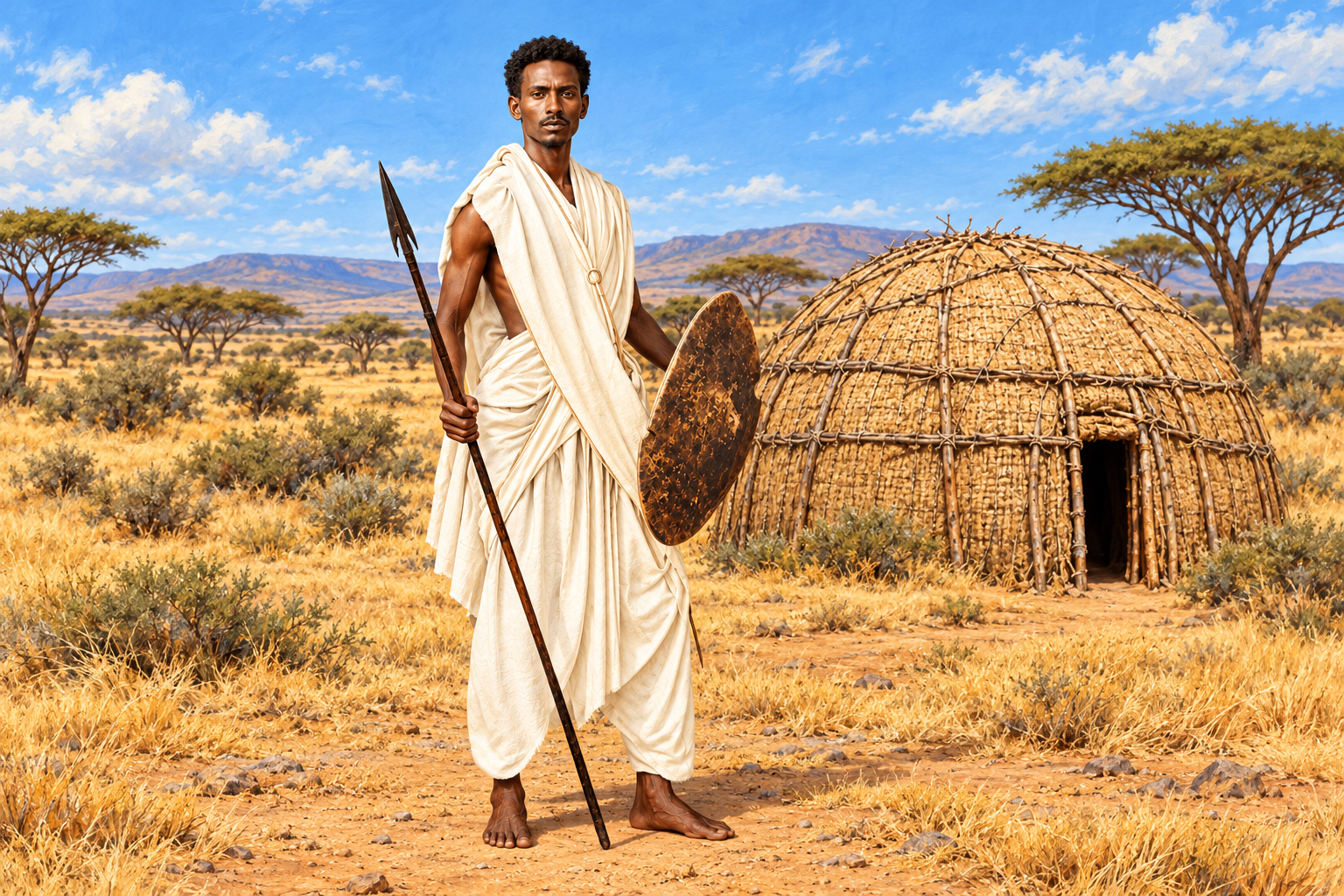
A man in flowing white cloth stands beside a rounded nomadic home, holding a spear and an elongated hide shield. The wide composition places his dress and equipment within a landscape of golden grass, acacia trees, and distant hills. Behind him, the dwelling’s curved framework and woven covering draw attention to the materials and practical knowledge involved in making a home. This 2D artistic interpretation was inspired by a historical portrait, with an imagined face, home, and landscape; it does not identify a particular person or documented settlement.
NOMADIC LIFE & LANDSCAPES
Aqal Soomaali: A Home Built for Movement
Architecture, weaving, and the knowledge carried between places.
- Name / subject
- Aqal Soomaali
- Place / community
- Somali pastoral communities; construction varies by place and period
Reading the image
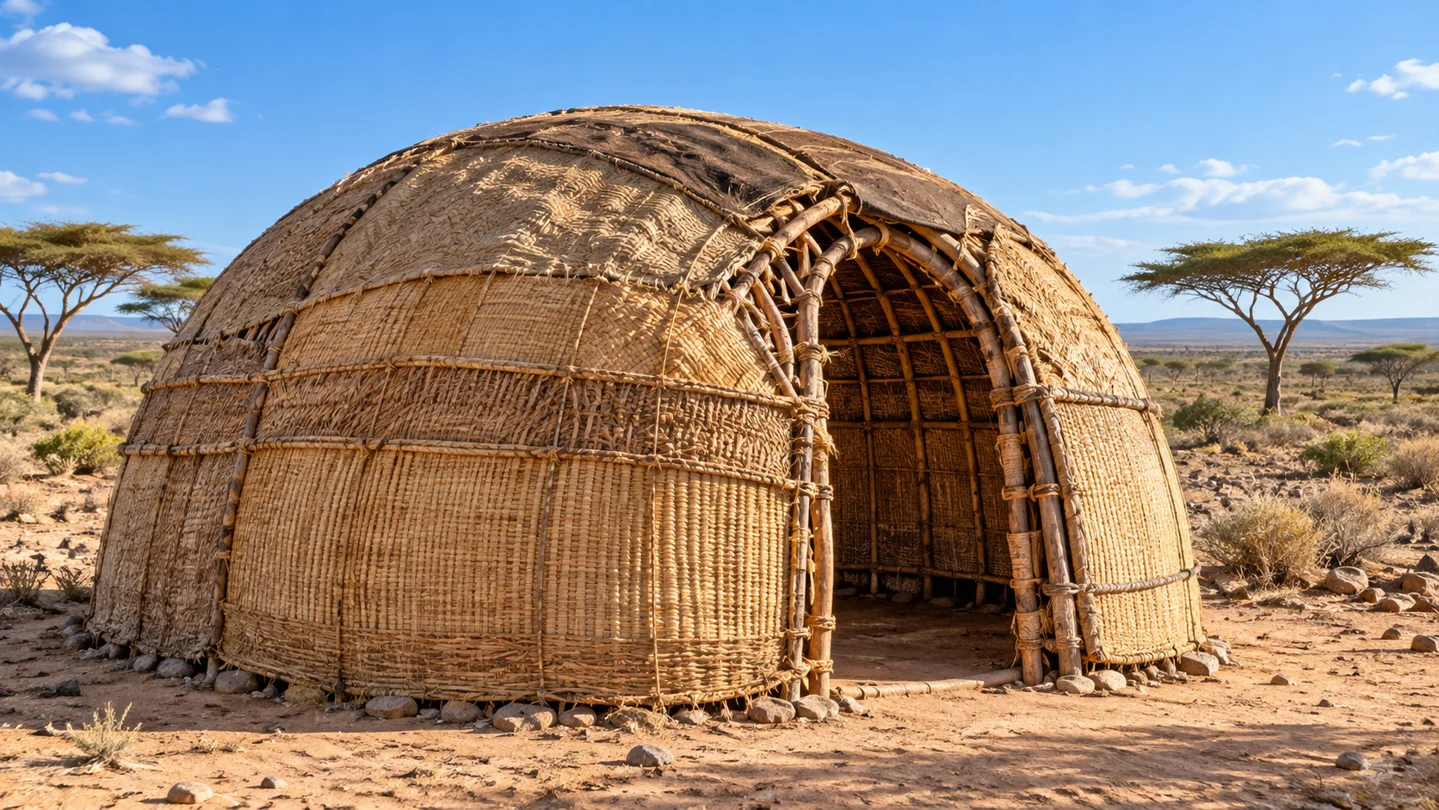
A rounded home stands in an open landscape, with woven coverings following the curve of its frame. At the entrance, the relationship between the supporting structure and the outer covering becomes easier to see. The image is an interpretation of an aqal rather than a photograph of a particular household. Its exact arrangement, surroundings, and materials should not be used as evidence for a named place or date.
A home that can travel
The aqal is associated with Somali nomadic domestic life. Its portability makes it an important starting point for understanding how a home can be connected to movement rather than a permanent site. Arlene Fullerton’s 1986 study, Handicrafts of the Nomadic Women of Somalia, examines the aqal alongside coverings, decorations, and household objects. The house is therefore part of a larger world of making, use, and care.
Structure and covering
The illustration separates two ideas that work together: a framework gives the shelter its rounded form, while woven material forms its covering. Looking at the home this way helps explain why the building cannot be understood only as an outline on a landscape. Its parts have to be made, joined, maintained, and handled. The study of an actual aqal should record those details from the makers and the object itself, rather than assume that every home uses an identical arrangement.
Women’s knowledge and work
Fullerton’s study focuses on handicrafts produced by nomadic Somali women, explicitly including the construction and decoration of the aqal. This places women’s skills at the centre of the architectural story. UNESCO’s discussion of Somali cultural heritage likewise recognises women’s role in passing knowledge between generations. To preserve a home’s history is also to preserve the names, techniques, and experiences of the people who made and maintained it.
A household, not an empty shell
In this museum, the aqal sits beside the story of the headrest and other everyday objects. That relationship is deliberate: a home is experienced through the things used within it, as well as through its walls. The image gives us an exterior view, but it also invites questions about the interior. Where were belongings kept, which objects travelled with the household, and who taught the skills required to care for them? Answers should come from specific testimony and documented examples.
What survives beyond the structure
An aqal’s significance extends beyond its appearance. Knowledge about making and maintaining a home can be remembered even when the original building no longer survives. Recording that knowledge gives younger generations another way to encounter family history. Look again at the covering and frame, and consider the number of different skills brought together in a single place of shelter.
← Back to all collections