
World Briefing | September 11, 2026
For decades, the international economic system has largely revolved around institutions and financial networks in which the United States and its Western allies hold enormous influence. The U.S. dollar remains central to global finance, while institutions such as the International Monetary Fund and World Bank have played major roles in shaping the economic order.
But another grouping has been steadily growing in size and ambition.
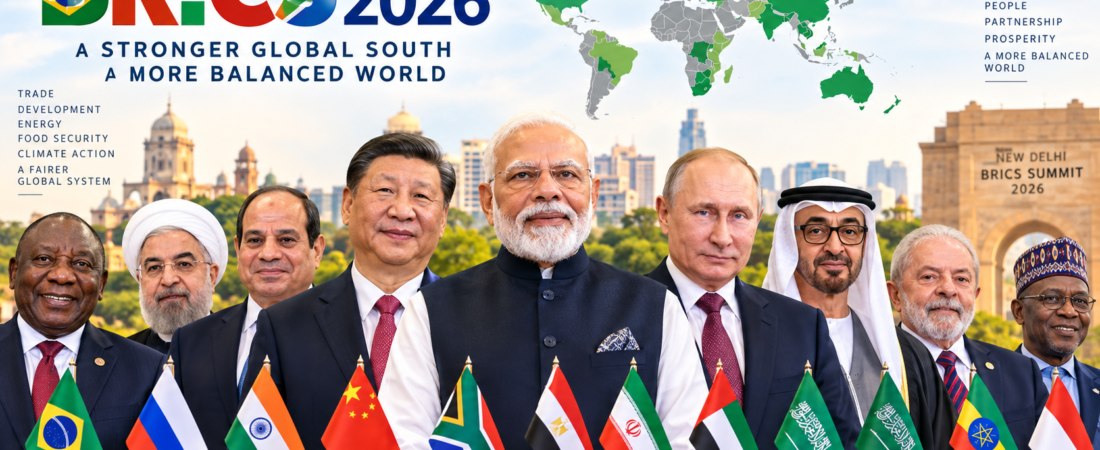
As world leaders gather in New Delhi for the 2026 BRICS summit, the question is becoming increasingly difficult to ignore:
Is BRICS merely a coalition of emerging economies — or are we witnessing the early stages of a genuine shift in global power?
What Happened
India is hosting the 18th BRICS Summit in New Delhi on September 12–13, bringing together leaders from an expanded organization that now includes 11 countries.
Russian President Vladimir Putin is already in India, where he met Prime Minister Narendra Modi ahead of the summit. Chinese President Xi Jinping and Iranian President Masoud Pezeshkian are among the major leaders expected to participate.
The gathering comes at an unusually turbulent moment. Wars in Ukraine and the Middle East, tensions between Washington and Beijing, disruptions to international shipping, energy insecurity and growing frustration among developing countries have all placed pressure on the existing international system.
BRICS leaders are expected to discuss economic cooperation, trade, financial reform and ways to reduce vulnerability to disruptions in the global economy.
One particularly important subject is the development of alternative payment mechanisms that could allow BRICS countries to conduct more trade without relying as heavily on the U.S. dollar.
Why It Matters
BRICS is no longer a small club of five emerging economies.
The expanded organization represents nearly half of humanity, giving it enormous demographic weight. Its members also include some of the world’s largest energy producers, consumers, manufacturing centers and rapidly developing economies.
China is one of the world’s largest economies.
India is one of its fastest growing major economies.
Russia remains a major energy and commodity power.
The organization also includes influential states across Africa, the Middle East, Southeast Asia and Latin America.
Together, these countries are demanding a greater voice in institutions created when the balance of global economic power looked very different.
That does not necessarily mean BRICS intends to destroy the existing international system.
For many members, the objective is more practical: gain greater influence within it while building alternatives where they believe the current system gives Western countries disproportionate power.
Who Benefits and Who Could Lose?
If BRICS succeeds in creating stronger financial and trading networks, developing countries could gain additional choices.
Countries that currently depend heavily on Western financial institutions could potentially gain new sources of development financing, investment and trade.
Russia and Iran have an especially strong incentive to support alternative financial systems because both have experienced extensive Western sanctions.
China also benefits strategically from a world in which international commerce is less dependent on American-controlled financial infrastructure.
India’s position is more complicated.
New Delhi maintains important relationships with Russia and other BRICS members while simultaneously developing deep economic and strategic ties with the United States and Europe. Rather than choosing one geopolitical camp, India has increasingly attempted to maintain relationships across competing centers of power.
For Washington and its allies, the greatest long-term concern may not be BRICS itself.
It may be the gradual creation of parallel institutions and financial networks that reduce the extraordinary influence Western countries have exercised over the global economy.
But BRICS Has a Major Weakness
Its size is also one of its greatest problems.
BRICS is not a military alliance, nor are its members united behind a single geopolitical ideology.
India and China are competitors as well as partners.
Russia and China frequently challenge Western influence, while countries such as India maintain substantial relationships with Washington.
Middle Eastern members have their own rivalries and strategic interests.
The wars involving Russia and Iran make those differences even more visible.
Creating a common declaration is one thing.
Creating a unified economic and geopolitical strategy among countries with competing interests is considerably more difficult.
That is why the 2026 summit matters.
The real test is no longer whether BRICS can attract new members or hold impressive meetings.
The test is whether it can turn its enormous collective weight into coordinated action.
What May Happen Next
Watch the financial system.
BRICS countries are likely to continue experimenting with trade in national currencies, new payment mechanisms and development financing outside traditional Western channels.
But replacing the dollar is an entirely different challenge.
The dollar’s power comes not simply from American political influence but from the enormous scale and liquidity of U.S. financial markets, international confidence in dollar-denominated assets and decades of global financial infrastructure built around the currency.
BRICS therefore does not need to replace the dollar completely to change the world economy.
Even gradually reducing dependence on it in certain areas of international trade could give governments more options.
And that may ultimately be the larger story emerging from New Delhi.
The global system may not be moving from American dominance directly to Chinese or BRICS dominance.
Instead, it could be moving toward something more complicated:
a world with several competing centers of economic and political power.
If that happens, BRICS 2026 may eventually be remembered not as the moment the old-world order disappeared but as another important moment when a new one began taking shape.
The Wider Chronicle — Go Beyond the Headlines.