
September 10, 2026
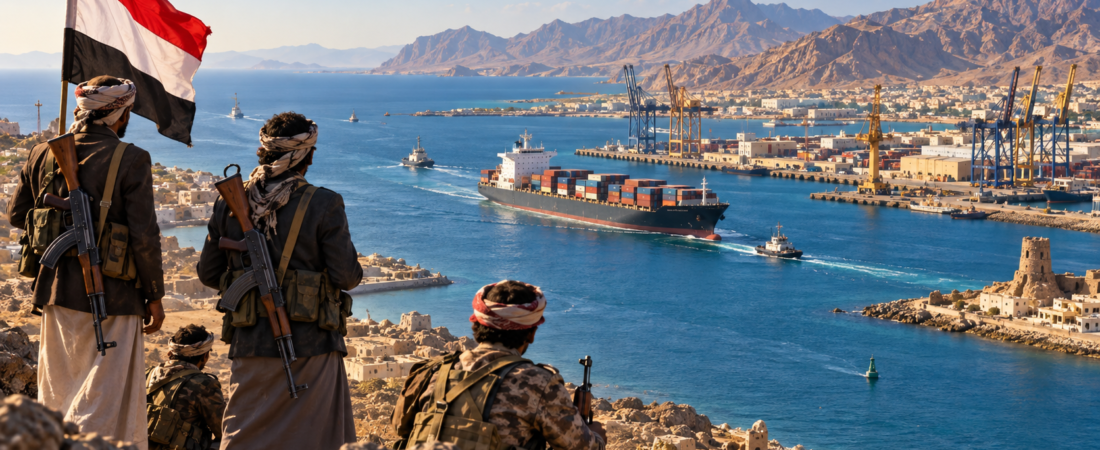
The Houthis’ reported capture of Mokha is far more than another territorial change in Yemen’s long civil war. It places an armed movement already capable of striking commercial vessels closer to Bab el-Mandeb, the narrow passage connecting the Red Sea with the Gulf of Aden and the wider Indian Ocean.
For Yemen, the advance threatens to reopen a conflict that had become less intense after the 2022 United Nations-brokered truce. For Saudi Arabia, it creates a new danger along an increasingly important export route. For the wider world, it raises a more immediate question: could instability around one Yemeni port disrupt the ships carrying oil, manufactured goods and food between Asia, Europe and Africa?
What happened
On September 10, 2026, Houthi forces claimed control of the strategic port city of Mokha on Yemen’s western coast. The Associated Press and Reuters reported the seizure, while Maj. Gen. Tareq Saleh, commander of the forces defending the area, acknowledged that his troops had conducted a strategic retreat to positions south of the city.
The offensive appears to extend beyond Mokha. Reports indicate that Houthi forces also claimed the inland city of Hays and the Khalid ibn al-Walid military base. Fighting and missile attacks have affected strategic positions and islands along the Red Sea coast, while Saudi Arabia has answered the escalation with airstrikes against Houthi targets.
The battle is the most serious escalation between the Houthis and Yemen’s internationally recognized, Saudi-backed government in years. Although the 2022 truce did not create a comprehensive peace settlement, it sharply reduced major cross-border fighting. The latest offensive now threatens to undo that relative calm.
Mokha historically famous as a center of the coffee trade—is located in Taiz province, north of the Bab el-Mandeb Strait. Control of the city does not automatically give the Houthis control of the strait. However, it expands their presence along the coast and brings them closer to positions from which the movement could place additional pressure on passing ships.
Why it matters
Bab el-Mandeb is one of the world’s critical maritime chokepoints. Ships traveling between the Indian Ocean and the Mediterranean normally pass through the strait, continue north through the Red Sea and enter the Suez Canal. If the route becomes too dangerous, shipping companies may divert vessels around the Cape of Good Hope in southern Africa.
That alternative can add considerable time, fuel consumption and insurance costs to a voyage. Those costs do not remain at sea. They can eventually appear in the prices businesses and consumers pay for fuel, food, machinery and other imported goods.
The danger is especially serious because the Houthis have already demonstrated an ability and willingness to attack ships with missiles and drones. Since late 2023, insecurity in the Red Sea has caused many shipping companies to avoid the area. A stronger Houthi position near the southern entrance to the Red Sea could make the threat more persistent and more difficult to contain.
The timing also matters for Saudi Arabia. With shipping through the Strait of Hormuz under pressure amid the wider confrontation involving Iran and the United States, the kingdom has become more dependent on its Red Sea infrastructure. Any threat to both Hormuz and Bab el-Mandeb would place two vital energy corridors under simultaneous strain.
This is why the battle for Mokha is not simply a local Yemeni event. It connects Yemen’s civil war with the security of international trade and with the larger contest among Iran, Saudi Arabia and the United States.
Who benefits and who loses?
The clearest immediate winner is the Houthi movement. Holding Mokha would strengthen its position along Yemen’s Red Sea coast, provide leverage in future negotiations and reinforce its claim to be a regional force rather than merely a domestic insurgency.
Iran may also gain strategic leverage. Tehran supports the Houthis with weapons and other assistance, although the movement has its own leadership, interests and decision-making. The advance gives an Iran-aligned organization greater influence near Bab el-Mandeb at a time when pressure is also mounting around the Strait of Hormuz.
The Saudi-backed Yemeni government is the most immediate loser. Its forces have surrendered strategically valuable territory, and divisions among the government’s military and political factions continue to weaken their response. The withdrawal of previous Emirati support from some southern forces has further complicated the anti-Houthi coalition.
Saudi Arabia also faces a difficult choice. It can intensify its military response and risk being drawn back into a costly Yemeni war, or exercise restraint and watch the Houthis consolidate their gains. Neither option offers an easy path to security.
Commercial shipping companies, energy importers and ordinary consumers could also lose. Higher insurance premiums, longer routes and rising oil prices can transmit the cost of this conflict far beyond Yemen. Yemeni civilians, however, remain the most vulnerable. Renewed ground combat and airstrikes threaten displacement, casualties and deeper hardship in a country already devastated by years of war and humanitarian crisis.
What may happen next
The first question is whether the Houthis can hold Mokha. Saudi airpower and regrouped Yemeni government forces may attempt to reverse the advance. Battles could also intensify around coastal roads, nearby military positions and the islands overlooking the approaches to Bab el-Mandeb.
The second question is whether the Houthis will use their stronger coastal position to expand attacks on Saudi-linked or international shipping. Even without closing the strait, the threat of missiles, drones or naval attacks may be enough to deter vessels and increase global transport costs.
Saudi Arabia may increase airstrikes and logistical support for Yemeni government forces while trying to avoid a full return to the ground war. The United States and its allies may strengthen maritime patrols, surveillance and air defenses around the Red Sea. Diplomatic pressure on Iran is also likely to grow, even as Tehran denies directing every Houthi decision.
The capture of Mokha does not mean the Houthis control Bab el-Mandeb. But it changes the geography of the conflict and narrows the distance between Yemen’s war and one of the arteries of the global economy. A battle for a port in one of the world’s poorest countries could soon affect tankers, cargo ships and household prices thousands of miles away.
The Wider Chronicle — Go Beyond the Headlines.