
THE WIDER CHRONICLE | STORIES
October 14, 2026
A portrait with a larger history
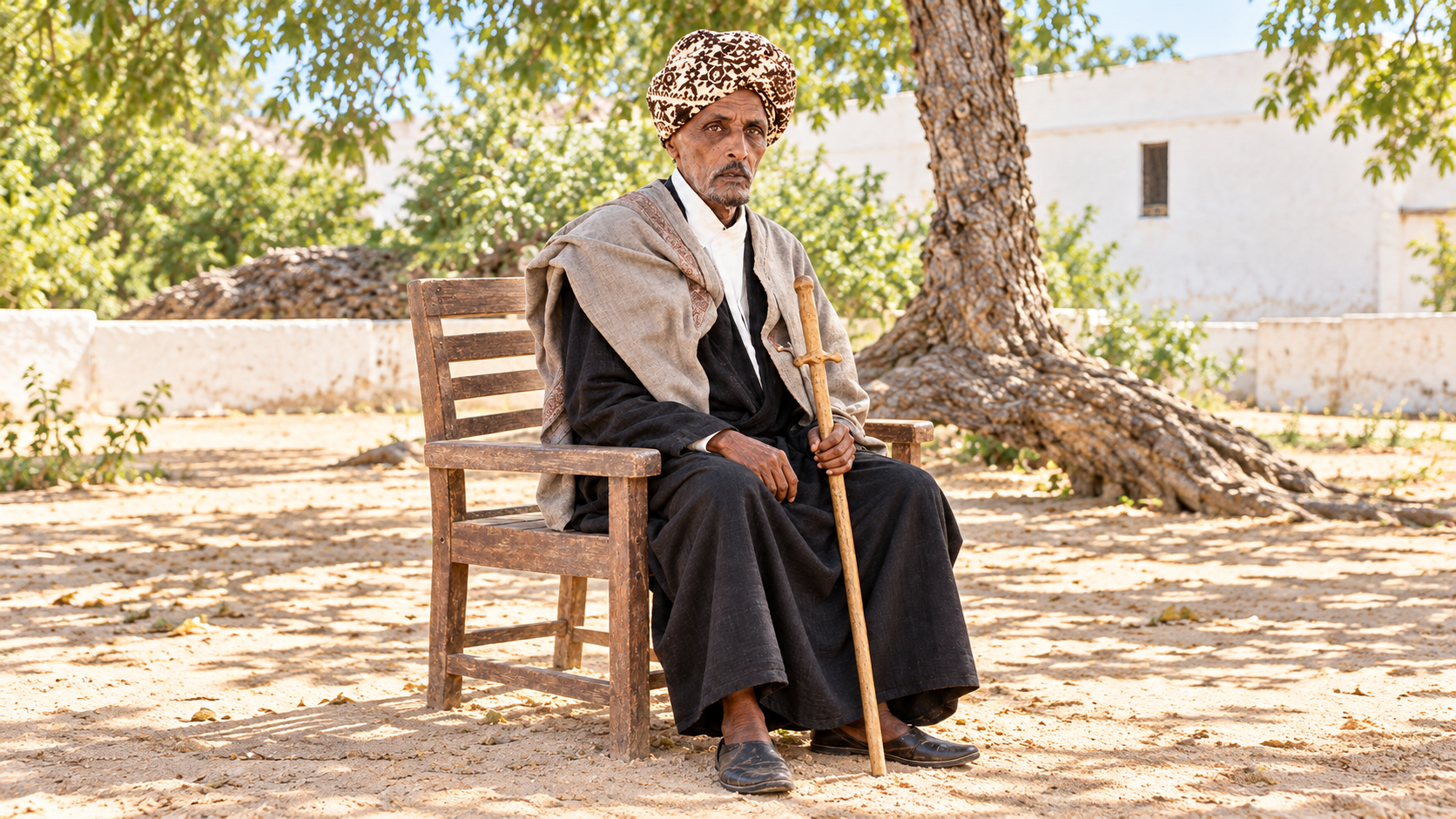
The man in the portrait wears a patterned turban and layered clothing, seated with a wooden staff beside him. His expression offers no simple explanation of what he endured. Yet the photograph invites a question that reaches beyond appearance: what happens when a powerful empire decides that a local ruler must be removed from his own people? For Sultan Mohamoud Ali Shire, that question became a lived experience of displacement, surveillance and a long struggle to return home.
Known in Somali as Maxamuud Cali Shire, he was a Warsangali ruler associated with Las Khorey in northern Somali territory. His historical title was Sultan, although readers may also encounter descriptions of him as a king or traditional ruler. His story belongs to a period when Somali political authority confronted expanding European control. Understanding it requires looking beyond a single arrest and considering the relationships that made his leadership meaningful.
Leadership before exile
A title alone cannot explain why a ruler matters. Authority depends on the people who recognise it, the disputes a leader can help settle and the relationships through which decisions are accepted. Seen in this way, removing a sultan is more than replacing a name in an administrative record. It can interrupt communication between a community and a person whose influence has developed over years. That is the political importance behind Shire’s otherwise quiet portrait.
Accounts of his career place him within the struggles involving British authorities and the Dervish movement led by Sayyid Mohammed Abdullah Hassan. This was a crowded political landscape, with local leaders making choices under pressure rather than moving through a simple division between empire and resistance. Shire’s independence became a problem for colonial administrators. Their response would eventually take him across the Indian Ocean, far from the setting in which his authority had been established.
Arrest and the journey away
Historian Mohamed Osman Omar, in The Scramble in the Horn of Africa, recounts Shire’s arrest in 1919 and removal through Berbera. The same account records his arrival in the Seychelles aboard HMS Odin on May 3, 1920. These details provide a firmer chronological foundation than repeating a general claim that he was simply exiled after the Dervishes’ defeat. Arrest, transportation and arrival were separate stages in the dismantling of his freedom.
The journey also changed the scale of the confrontation. A dispute rooted in northern Somali territory was now administered through an imperial network of ports, ships and officials. The person being moved did not control the route or destination. His homeland became somewhere he could remember, write about and request permission to reach, rather than somewhere he could return to by his own decision.
What the colonial letter reveals
A surviving colonial letter concerning his deportation draws a revealing distinction between imprisonment and political detention. It instructed officials to treat the former sultan as a political detainee, while expressing concern that he might escape and return to Warsangali territory. The correspondence requested careful surveillance because such a return could have serious political consequences. This is direct evidence that authorities considered his continuing influence important, even after removing him.
The language deserves careful attention. An official distinction between detention and imprisonment does not tell us that a person was free. The decisive question is whether he could choose to leave. Nor should we mistake the administrators’ description of political danger for an impartial account of Shire’s character. The letter records the government’s priorities: keeping him away, monitoring his movements and preventing a return it feared would disturb colonial control.
The Seychelles beyond the postcard
The Seychelles can appear in modern imagination as a place of beaches, clear water and holidays. Shire’s experience gives those islands another historical meaning. They formed part of Britain’s system of political exile, receiving opponents from different territories. Research by Uma Kothari examines how compulsory relocation was used to contain resistance and how those affected continued challenging authority despite isolation and loss.
That research also identifies a contradiction. Moving opponents to the same distant islands could create connections between people who otherwise might never have met. The empire sought separation from home, yet exile could generate new relationships and exchanges. This wider pattern helps explain why distance alone was an uncertain instrument of political control. It could restrict someone’s movements without necessarily extinguishing their ideas or their determination to return.
The struggle continued in letters
Biographical accounts describe Shire repeatedly appealing for permission to return, emphasising his wish to rejoin his family and offering assurances to colonial authorities. Such petitions are essential to the story because they show action during apparent confinement. Exile did not mean the end of political effort. It changed the available means, making correspondence and requests important tools for a man deprived of control over his destination.
Reading these appeals requires restraint. We cannot confidently reconstruct every private motive behind words addressed to officials who controlled his release. A promise might express sincerity, exhaustion, negotiation or several things together. The responsible interpretation is to recognise the unequal relationship in which the letters were written. A person asking to go home had to persuade the very administration that had decided he should remain away.
Return in 1928
Omar records that Shire left the Seychelles aboard SS Karapara on May 20, 1928, travelling toward Bombay and then returning through Aden. Approximately eight years had passed since his arrival on the islands. The dates establish the length of his absence without requiring imagined conversations or dramatic scenes. His journey home marked a major change in circumstances, but it did not erase the political order that had made exile possible.
Accounts of his later life describe an accommodation with British administration and the eventual restoration of his status as sultan. This complicates any attempt to present him only as an uncompromising opponent who never adjusted his position. Accommodation under colonial rule could coexist with continuing local influence. His life therefore invites a more demanding question: how did leaders preserve a role for themselves and their communities when the balance of power had changed?
Remembering without simplifying
Historical memory often prefers a clear hero, an obvious enemy and a decisive final victory. Shire’s experience offers something more difficult and more human. Removal, prolonged absence, petitions and return do not form a neat ending. They reveal leadership under constraint. Acknowledging negotiation does not make exile insignificant, just as acknowledging resistance does not require claiming that every later decision followed one unchanging political strategy.
The restored portrait should be understood with equal care. Its face and visible clothing are based on the supplied historical photograph, while its colors and expanded framing are interpretive. It can help readers connect with the subject, but it cannot establish the original colors of his garments or reproduce missing details with certainty. The historical argument must rest on records and scholarship, rather than on the apparent realism of a reconstructed image.
Why his story deserves a place
For readers encountering him for the first time, Shire offers an entry into a history larger than one ruler. His experience connects Somali leadership with the Indian Ocean and the machinery of colonial removal. It also directs attention toward what official records can obscure: the personal cost of being denied a return. Dates explain when exile happened; careful reading helps us understand why that denial matters.
Remembering him carefully means preserving both his dignity and the difficult political circumstances that shaped his exile and eventual return.
Image: Reconstructed color portrait based on a historical photograph identified as Sultan Mohamoud Ali Shire. Colors and areas outside the original frame are interpretive.
Sources and historical notes
Mohamed Osman Omar, The Scramble in the Horn of Africa, printed page 458, for the arrest, arrival and return chronology; Uma Kothari, Contesting colonial rule: Politics of exile in the Indian Ocean, Geoforum 43 (2012), pages 697–706, for exile and resistance; Colonial deportation correspondence, for the distinction between political detention and imprisonment and concern about his return; Biographical overview and references, including William McAteer’s history of Seychelles, for leadership, petitions and restoration of status.

Spellings of his name vary between sources. This account avoids uncertain reign dates, disputed family relationships and imagined private dialogue. Interpretation is distinguished from the documented chronology.