
THE WIDER CHRONICLE
October 11, 2026 | Stories
Syria’s descent into hell did not begin with the first battles of its civil war. Long before cities were reduced to rubble, a political order had taken shape in which the state could imprison, silence and kill people who challenged its rulers. Hafez al-Assad established the family’s long grip on power; his son Bashar inherited its machinery and presided over a catastrophe that reached far beyond Syria’s borders.
Their legacy is more than the fall of a dynasty. It is the damage done when a ruling family treats its survival as the nation’s highest purpose, leaving citizens with little protection against the institutions meant to serve them. The record of repression, mass killing and disappearance explains why the word “hell” carries such force in the Syrian story.
The father’s state: power without accountability
Hafez al-Assad ruled from 1970 until his death on June 10, 2000. By the time his son succeeded him, Syrians still faced severe restrictions on expression, association and assembly, while emergency powers gave security agencies sweeping authority. Human Rights Watch’s account of the succession described a country without effective safeguards against arbitrary detention and torture. Political power changed hands within a family while the structures that protected the rulers remained intact.
That arrangement made accountability almost impossible. A citizen challenging official wrongdoing faced institutions whose authority depended on the same leadership being challenged. In such a system, silence could become a practical means of survival, and the absence of public opposition could be presented as evidence of popular consent. Stability purchased through fear left the grievances beneath it unresolved.
Hama: the warning written in blood
Hama became the most notorious expression of Hafez’s rule. In February and March 1982, government forces fought an Islamist uprising and subjected the city to a devastating military assault. Human Rights Watch documented bombardment, mass executions and thousands of deaths; estimates of the total vary, and no single figure should be treated as conclusively established. The existence of armed opposition did not justify killing civilians or executing people outside any lawful process.
The violence extended beyond Hama. Human Rights Watch recorded the June 1980 killing of an estimated 1,000 unarmed prisoners at Tadmor by forces commanded by Hafez’s brother, Rifaat al-Assad. These events made repression a national warning: challenging the regime could carry consequences far beyond an individual arrest. Families were left with losses that the state neither adequately acknowledged nor answered for.
The son’s promise, and the door that closed
Bashar’s arrival in 2000 raised hopes that a younger president might allow political reform. Instead, the succession was orchestrated through the ruling party and a presidential referendum offering only one candidate, according to Human Rights Watch’s contemporary report. Syrians received a new ruler without a meaningful opportunity to choose a different government. A modern public image could not substitute for a transfer of power to citizens.
The brief Damascus Spring allowed activists to discuss political change before a crackdown in 2001. Human Rights Watch’s 2010 assessment documented continuing arrests and torture. The failure of reform was visible a decade before the uprising.
2011: when protest met the security state
In March 2011, protests in Daraa followed the arrest and torture of schoolchildren, according to Human Rights Watch. Security forces opened fire on demonstrators, and protests spread. The government portrayed the unrest as the work of armed enemies, but the organization found that most demonstrations it had documented during the early uprising were largely peaceful. Armed attacks also developed, and the conflict became increasingly violent.
A December 2011 investigation based on interviews with 63 military and intelligence defectors documented orders to fire on protesters and campaigns of arbitrary arrest and torture. Human Rights Watch concluded that abuses were ordered, authorized or condoned at high levels, and identified grounds for investigating Bashar and senior officials under command responsibility. Its findings describe decisions made within a chain of authority, rather than isolated misconduct by a few guards or soldiers.
The war eventually drew in numerous armed groups and foreign powers. Opposition factions also committed grave abuses, and Russia and Iran supported Assad’s government. Those facts matter to a complete account of the conflict. They do not erase the regime’s responsibility for its own crimes or the central role of repression in turning political demands into a national disaster.
The prisons behind the portraits
The scale of suffering becomes clearest inside the detention system. Amnesty International’s 2017 investigation estimated that as many as 13,000 people were secretly hanged at Saydnaya between 2011 and 2015, most of them civilians believed to oppose the government. The estimate concerns a particular prison and period, not a confirmed total for every Syrian detention site. Amnesty also documented torture and deliberate deprivation of food, water and medical care.
The organization described proceedings that denied detainees meaningful trials or access to lawyers, and concluded that the abuses amounted to war crimes and crimes against humanity. For families, disappearance prolonged the harm: imprisonment could mean losing even the ability to discover whether a relative remained alive. The prison system punished those detained while spreading fear and uncertainty beyond its walls.
Destruction beyond the prison walls
The evidence of violence against civilians also includes chemical weapons. In January 2023, the Organisation for the Prohibition of Chemical Weapons reported reasonable grounds to identify the Syrian Arab Air Forces as responsible for the April 7, 2018 chlorine attack in Douma. Investigators concluded that cylinders dropped onto residential buildings killed 43 named people and affected dozens more. This was an investigative finding, not a criminal judgment establishing any individual’s guilt.
The human cost cannot be measured through one attack or prison. In its account following Assad’s fall, UNHCR reported that more than 13 million Syrians had been forced from their homes over nearly fourteen years of conflict and crisis. Behind that historical figure were interrupted educations, lost livelihoods and families dispersed across borders. For refugees, the destruction of a home also meant losing the place where ordinary life had once been possible.
The dynasty fell; its consequences remained
Bashar al-Assad’s government was overthrown on December 8, 2024, ending the family’s decades in power. Human Rights Watch reported that advancing opposition groups freed detainees and that access to former detention sites created new opportunities to investigate atrocities. The same organization documented abuses by opposition groups, underlining that the removal of one ruler does not itself guarantee lawful government. Freedom requires institutions that restrain whoever holds power next.
Responsibility must attach to people who ordered, committed or enabled crimes, established through evidence and fair proceedings. It must never become collective punishment against Alawites or any other religious or ethnic community. Replacing one system of fear with another would betray the people whose suffering makes accountability necessary.
Hafez built a political order that denied Syrians meaningful control over their government. Bashar preserved its coercive foundations and led it into a war whose consequences will outlast his rule. Syria’s descent into hell was not an inevitable feature of its people or history. It was shaped by decisions to defend power through repression, and its recovery depends on making those decisions impossible to repeat.
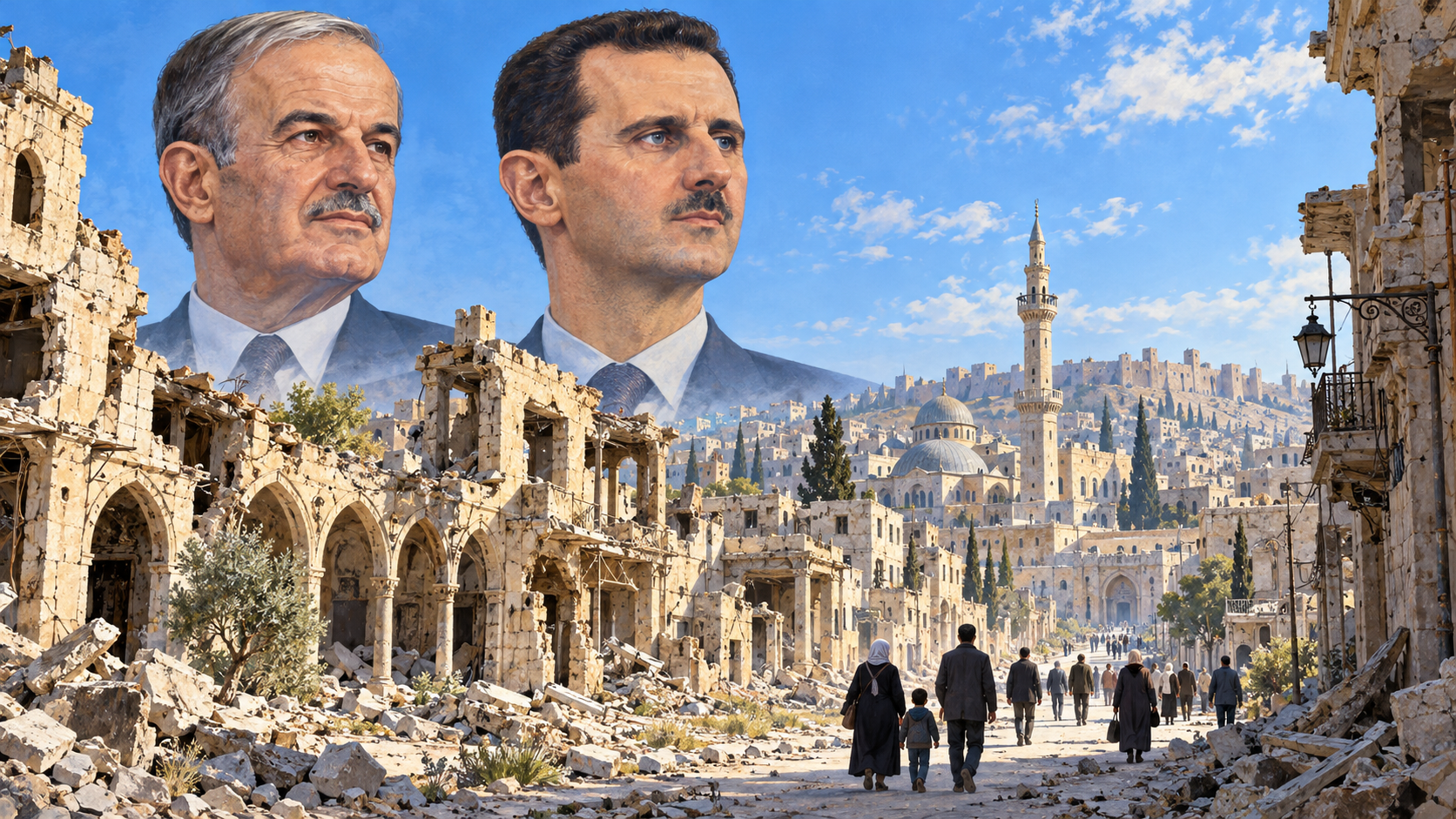
Historical analysis. Displacement figures refer to the period stated in the source. Featured image: AI-generated editorial illustration; not a photograph of a specific event.
Sources: Human Rights Watch: Syria and the 2000 succession; Human Rights Watch: A Wasted Decade; Human Rights Watch: the 2011 crackdown and command responsibility; Amnesty International: Saydnaya investigation; OPCW: Douma investigation; UNHCR: Syria’s displacement crisis; Human Rights Watch: World Report 2025, Syria.