
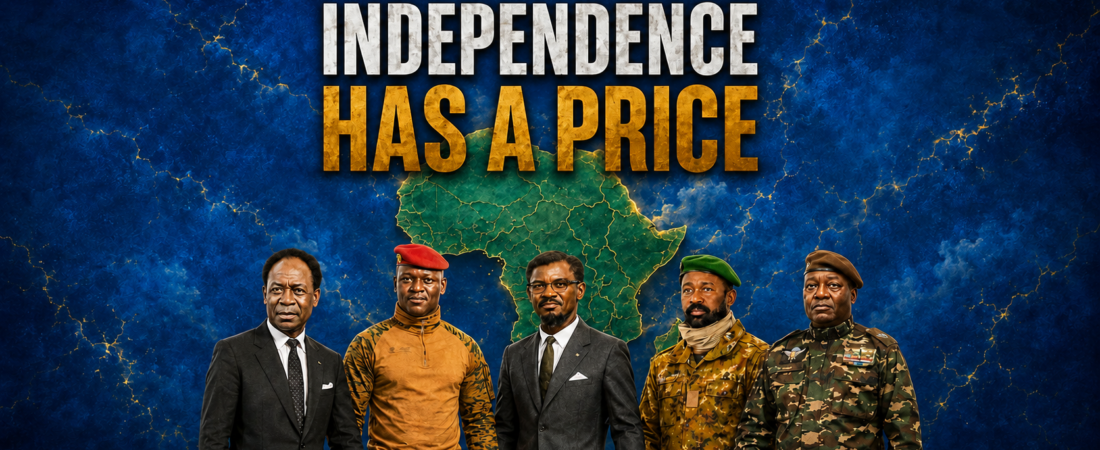
Political independence can be celebrated in a single day. A flag is raised, an anthem is played, and a new government takes office.
Economic independence is far more difficult.
A country may control its parliament while foreign companies control its mines. It may have a national anthem while depending on decisions made in distant capitals. It may possess extraordinary natural wealth while most of its people remain poor.
This is the unfinished struggle that has shaped modern Africa. Again and again, African leaders have tried to turn political independence into economic sovereignty. Some were overthrown. Others were assassinated. Their stories are different, but they raise the same disturbing question:
What happens when an African leader decides that the wealth of Africa should primarily serve African people?
Patrice Lumumba: Independence Without Control
When the Congo gained independence from Belgium on June 30, 1960, it inherited one of the richest territories on Earth.
Its soil contained copper, cobalt, diamonds, uranium and other valuable minerals. Yet much of the economy remained connected to Belgian companies and foreign interests. Political power had officially changed hands, but control over the country’s enormous wealth had not completely followed.
At the independence ceremony, Belgium’s King Baudouin praised the colonial legacy of King Leopold II. Patrice Lumumba, the Congo’s newly elected prime minister, responded with an unscheduled speech reminding the world that Congolese independence had been won through struggle, humiliation and bloodshed.
Lumumba wanted a united Congo capable of controlling its territory and resources. That position placed him at the centre of a Cold War confrontation almost immediately.
Within weeks, the mineral-rich province of Katanga broke away with Belgian support. The United States increasingly viewed Lumumba as a threat because it feared he might move the Congo closer to the Soviet Union. Declassified American records show that the United States began a covert political program intended to remove him from power, while CIA officials also explored plans to assassinate him. A later Belgian parliamentary inquiry acknowledged the moral responsibility of certain Belgian officials and other Belgian participants in the circumstances surrounding his death.
Lumumba was removed from office, captured and executed on January 17, 1961. He was only 35 years old.
His death demonstrated a painful reality: gaining a flag did not mean that a newly independent African country was free to choose its economic or political direction without outside interference.
Kwame Nkrumah: Political Freedom Was Not Enough
In 1957, Ghana became the first sub-Saharan African colony to gain independence from European rule in the postwar era. Its first prime minister, and later president, Kwame Nkrumah, became one of the most influential voices of Pan-Africanism.
Nkrumah believed that the liberation of one African country meant little if the continent remained economically dependent and politically divided. He promoted African unity, industrial development and greater African control over national wealth.
For Nkrumah, colonialism had not simply disappeared. It had changed its methods.
Foreign governments no longer needed to administer African territories directly if they could continue influencing their economies, resources and political decisions. Nkrumah called this system neocolonialism: independence in appearance, but dependence in practice.
His government built roads, schools, health facilities and major infrastructure projects. However, his rule also became increasingly authoritarian. Ghana was made a one-party state, political opponents were detained, ambitious development projects created financial pressure, and economic difficulties produced growing public dissatisfaction.
In February 1966, while Nkrumah was visiting Asia, Ghana’s military and police overthrew his government. American archival records show that U.S. officials knew about coup plotting before it occurred, although the surviving public record does not establish that Washington directly organized the final takeover.
Nkrumah spent the remainder of his life in exile.
His removal cannot be explained by foreign interests alone. Ghana had serious domestic political and economic problems. But his central warning survived him: a country can be politically independent while its economic choices remain constrained by forces beyond its borders.
Thomas Sankara: A Revolution of Self-Reliance
Two decades later, Thomas Sankara attempted an even more radical experiment in Burkina Faso.
Sankara came to power in 1983, when the country was still called Upper Volta, a name inherited from French colonial rule. He renamed it Burkina Faso, commonly translated as “Land of Upright People.”
His revolution was built around self-reliance. Sankara encouraged citizens to consume locally produced goods, challenged government corruption and rejected the idea that African development must always depend on foreign assistance.
His government promoted vaccination, literacy, agricultural production, reforestation and women’s participation in public life. It campaigned against forced marriage and female genital mutilation while trying to redirect state resources toward ordinary citizens.
Sankara also criticized Africa’s foreign debt. He argued that debt had become a mechanism through which wealthy countries and financial institutions continued to influence African governments.
But Sankara’s government was not without serious faults. His revolutionary committees and tribunals were accused of arbitrary detention and suppressing political opponents. His reforms also threatened powerful domestic groups, including traditional authorities, sections of the military and political elites.
On October 15, 1987, Sankara was assassinated during a coup led by forces associated with his former friend Blaise Compaoré. He was 37 years old. In 2022, a Burkinabè military court convicted Compaoré in absentia of complicity in Sankara’s murder and sentenced him to life imprisonment.
Many of Sankara’s policies were reversed after his death. Yet his image still appears across Africa because his message remains powerful: a poor country should not have to surrender its dignity in order to survive.
The Struggle Returns to the Sahel
Today, the language of sovereignty has returned across the Sahel.
The military governments of Mali, Burkina Faso and Niger have expelled or reduced the presence of traditional Western partners, withdrawn from the Economic Community of West African States and formed the Alliance of Sahel States.
They have also demanded greater national control over gold, uranium and other strategic resources. Mali has revised its mining rules and begun developing a refinery intended to process more gold domestically. Niger has challenged longstanding French interests in its uranium industry, while Burkina Faso has sought a larger national role in the gold sector.
To many Africans, these actions represent a long-delayed challenge to economic arrangements inherited from colonialism.
But sovereignty cannot be measured by speeches alone.
Mali, Burkina Faso and Niger are governed by military authorities rather than elected civilian governments. They continue to face devastating insurgencies, displacement, economic pressure and accusations of human-rights abuses. Replacing Western dependence with dependence on another foreign power whether Russia, China or anyone else would not create genuine independence.
Control over natural resources matters, but it must produce schools, hospitals, infrastructure, employment and security. If national wealth benefits only a new political or military elite, the structure of exploitation remains intact even when the flag above it changes.
Independence Has a Price
Lumumba, Nkrumah and Sankara were not identical leaders. They governed different countries, confronted different challenges and made different mistakes.
Their removal cannot be reduced to one secret conspiracy. Domestic rivalries, economic crises, Cold War politics, military ambition and foreign interference all played important roles.
Yet a clear historical pattern remains.
Political independence was often accepted more easily than economic independence. Raising a national flag was one thing. Challenging the control of minerals, trade, finance and strategic territory was another.
That is why the struggle for sovereignty is still unfinished.
True independence is not simply the absence of foreign rulers. It is the ability of a people to determine their political future, control their national wealth and use that wealth to improve their own lives.
Africa does not need isolation from the world. It needs partnerships negotiated with dignity, transparency and genuine equality.
The final question is therefore not only about the leaders who were overthrown or killed. It is about the nations they left behind:
Can a country be truly independent if it does not control the wealth beneath its soil?