
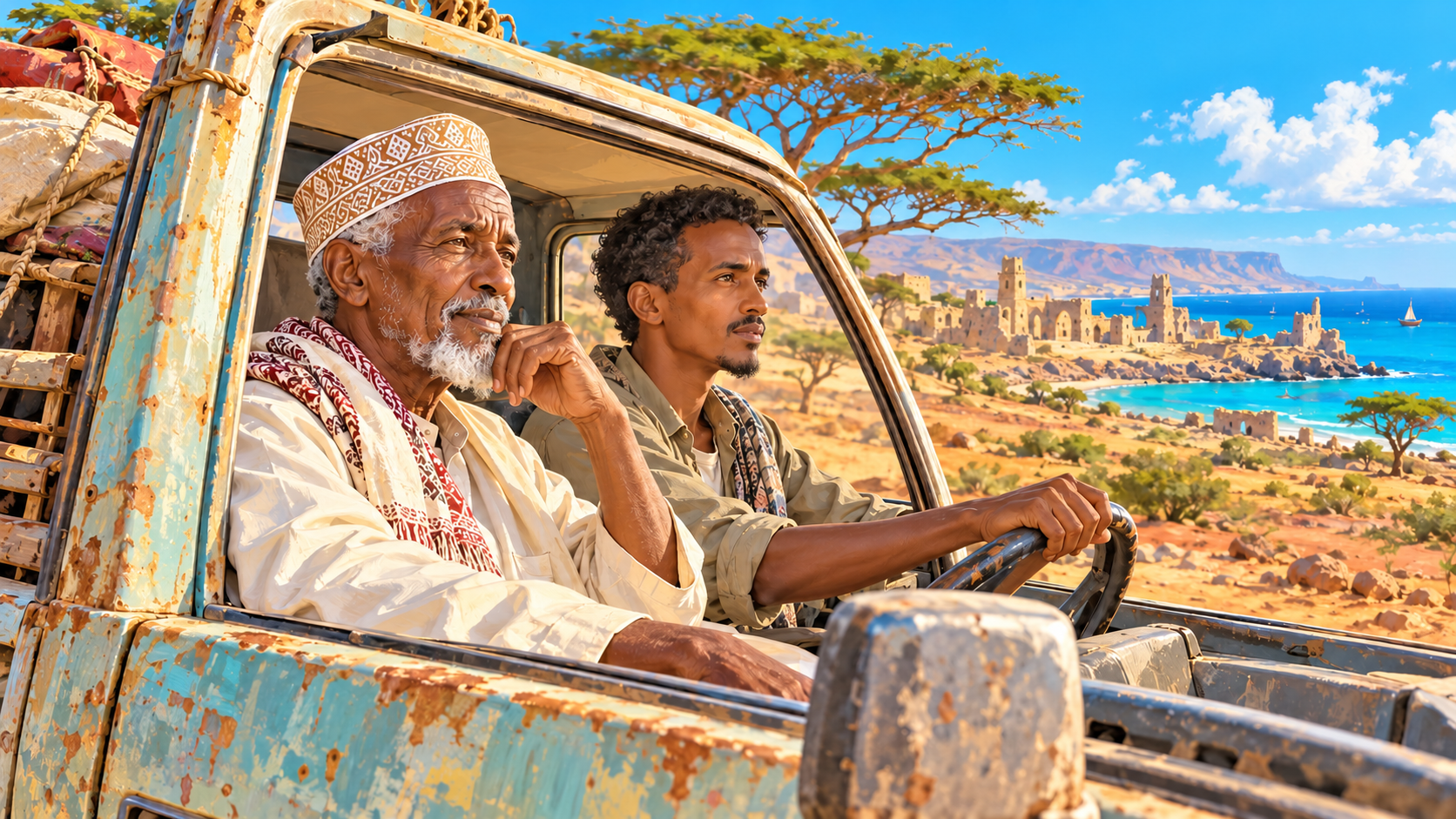
The morning sun broke over the ancient northern port of Zeila, casting long shadows from the ruins of a centuries-old mosque toward the red dirt road where an old truck sat idling. Inside the cab, Warsame and his nephew, Liban, were preparing for the long drive south toward Hargeisa. Though they shared the same blood, their minds lived in two entirely different eras.
Warsame, the elder, was born in the final years of the British Protectorate. He remembered a time when borders were merely abstract lines drawn on paper by foreign diplomats. To him, the land was defined by seasonal pastures, shared wells, and the Xeer the customary law that bound all Somalis together long before European ships ever docked on the coast.
Beside him sat Liban, a young man who had grown up entirely within the de facto borders of an unrecognized Somaliland. A child of the 1990s, Liban’s earliest memories were shaped by the aftermath of the civil war and the stories of the military regime flattening his family’s hometown. To Liban, the state was real because it had kept the peace during his lifetime. He carried a Somaliland passport in his pocket, even if the rest of the world refused to stamp it.
As the truck rattled along the highway, the radio buzzed with political talk about international borders, colonial treaties, and sovereign rights.
Warsame sighed, waving a hand toward the dashboard. “Turn that off, Liban. Every day, the same shouting on the airwaves. They speak as if our history began only when the British and the Italians arrived with their transit lines.”
“It’s not just shouting, Uncle,” Liban replied, keeping his eyes on the road. “It’s international law. We were British Somaliland. We gained our independence first, in June of 1960. We were a distinct country before we rushed into a union that ended in disaster. We are simply reclaiming the borders we inherited.”
Warsame let out a soft, dry laugh. “Reclaiming what borders? Look out that window. Before the British came to the north and the Italians took the south, what was this place? Did the Adal Sultanate stop its trade because of a border? Did our ancestors in the south ask for a visa to walk from the rivers to the Gulf of Aden? We were a single cultural nation of independent sultanates and pastoral republics, never two separate countries.”
“That was centuries ago,” Liban argued, gripping the steering wheel a little tighter. “The world has changed, and we have to live in the reality of today. Look at the peace we built here in the center while Mogadishu struggled for decades. But even now, we are stuck. Our youth can’t travel, our degrees aren’t recognized, and our economy is strangled because the world pretends we don’t exist.”
He paused, glancing at his uncle. “I know the population isn’t fully united. The people in the eastern regions like Sool and Sanaag look south and feel a pan-Somali identity. They don’t want this separation. But here in the core, we look south and remember the bombs. Why should we hitch our wagon to a collapsed house just because we share a language?”
Warsame looked out at the passing acacia trees. He understood his nephew’s fear; the trauma of the past was a heavy wall to pierce.
“I do not ask you to love a corrupt central government, Liban,” the old man said softly. “But do not mistake a political grievance for a permanent historical truth. If you base your entire right to exist on a border drawn by a British committee in 1888, you are admitting that a colonial pencil has more authority than your own ancestry. If we permanently divide a single people based on foreign lines, then the colonizers win, even a century after they left.”
The truck crested a hill, and the sprawling lights of Hargeisa appeared in the valley below—a bustling, vibrant city moving forward despite its political limbo.
Liban slowed the vehicle as they approached a security checkpoint. A young soldier dressed in a Somaliland uniform stepped forward, raised his hand, and peered into the cab. Recognizing Warsame, the soldier gave a polite nod of traditional respect to the elder and waved them through.
As they entered the city streets, a quiet settled between the two men. It was the same profound silence that hung over the entire region a deep, unresolved struggle between a young man looking at the borders on his map, and an old man looking at the roots beneath the soil.